Tổng số lượt xem trang

Thứ Tư, 9 tháng 6, 2021

Education leads to confidence for new POCUS users

By Amerigo Allegretto, AuntMinnie.com staff writer


June 9, 2021 -- Instructional training increases confidence among family medicine residents using point-of-care ultrasound (POCUS), according to a study published June 4 in Family Medicine.

team of researchers from the University of New Mexico led by Dr. Jerica Johnson found residents felt "significantly more confident" in their ability to perform and interpret a POCUS exam after a curriculum was implemented and that baseline attitudes toward POCUS were "very" favorable in both the pre- and postintervention surveys.

"Our residents and faculty have all been very excited to use POCUS. There are of course barriers to adoption of any new technology," Johnson told AuntMinnie.com. "The most significant barrier has been residents and faculty feeling that they are trained well enough to use POCUS and that there is not enough time to obtain this training."

The use of POCUS in family medicine residency training is increasing. However, researchers said attitudes about the technology, including confidence levels with performing and interpreting POCUS exams, are unknown.

The team wanted to find out attitudes and confidence levels of family medicine residents before and after the implementation of a new POCUS curriculum.

Residents in their postgraduate years at the University of New Mexico Family Medicine Residency Program were trained with POCUS in a yearlong program. The university's current POCUS curriculum was implemented in 2017.

"We had a loose curriculum with limited POCUS experiences prior to this when we made intentional changes to create a robust POCUS curriculum," Johnson said.

Attitudes and confidence levels with various POCUS exams were assessed through pre and postintervention surveys. On a 5-point confidence scale, a score of 1 meant strong disagreement while 5 indicated strong agreement.

The research team held a three-hour, hands-on workshop for residents, an 18-hour workshop for faculty and residents who participated as volunteer models, and 30-minute sessions every other week for residents who were rotating on the program's inpatient service.

Twenty-one residents responded to the preintervention survey. The average confidence scale score for education on ultrasound principles for performing and interpreting POCUS exams was 4.38. For the postintervention survey, which included 25 residents, that score was 3.96 (p = 0.05).

While agreement was high among residents when it came to ready access to ultrasound equipment and hands-on training, the results did not achieve statistical significance.

The team wrote that future research opportunities include investigating the effectiveness of different POCUS training technologies among family medicine residents and effects on patient-oriented outcomes.

Johnson told AuntMinnie.com that the team is hoping to implement an outpatient-based curriculum for the university's family medicine residents that is geared toward POCUS applications that are useful in the outpatient clinic.

"We are hoping to demonstrate that minimal training interventions can lead to improved revenue generation from the POCUS exams and essentially provide evidence that POCUS training for family medicine residents 'pays for itself,'" she said. "We hope that this outpatient-based curriculum can then be shared and applied by other family medicine residency programs.

Thứ Sáu, 4 tháng 6, 2021

SHORTER LUNG U S exams can help kidney disease patients


By Amerigo Allegretto, AuntMinnie.com staff writer

June 4, 2021 -- Lung ultrasound with an abbreviated scanning protocol can efficiently diagnose pulmonary congestion caused by fluid overload in hemodialysis patients, according to research published June 3 in the American Journal of Kidney Diseases.


team of researchers led by Dr. Nathaniel Reisinger from the University of Pennsylvania found that several abbreviated lung ultrasound protocols that focus on a limited number of lung zones (4, 6, or 8-zone) performed similarly to comprehensive 28-zone studies among patients with kidney failure on hemodialysis seeking care in an emergency department.

The researchers also did not find any differences in mortality between patients with no-to-mild and moderate-to-severe pulmonary congestion.

"Abbreviated lung ultrasound protocols take less time, are less bothersome to patients, and are nearly as accurate," Reisinger told AuntMinnie.com.

Pulmonary congestion from fluid overload is common among patients with kidney failure on hemodialysis and contributes to excess morbidity and mortality in patients. The team said that physical examination is an insensitive approach to detecting pulmonary congestion.

Lung ultrasound with a comprehensive 28-zone protocol has been shown to be sensitive for detecting pulmonary congestion, according to previous research. However, the 28-zone technique requires complete disrobing of the patient and longer scanning times for operators.

"In the constrained environment of the emergency department, this commitment is prohibitive to both patients and providers," the authors wrote.

Reisinger and his team wanted to see if abbreviated forms of lung ultrasound could produce similar results while saving time for operators and providing a more comfortable experience for patients.

The group started with research by Buessler and colleagues that studied the use of four-, six-, and eight-zone scanning for heart failure patients, as well as mapped the specific lung zones that would be most equivalent to a 28-zone study. The researchers noted that previous research has found that the regional distribution of pulmonary edema on imaging based on clinical condition has been well-demonstrated.

They then tested the protocol in 98 patients in the U.S. with kidney failure on hemodialysis participated, with a follow-up time of 30 days. Out of those, 84 were African American and 97 were non-Hispanic or Latino in ethnicity.

The team found high correlation and good agreement between 28-zone and abbreviated lung ultrasound studies. Each of the short-form studies was able to discriminate between no-to-mild pulmonary congestion versus moderate-to-severe pulmonary congestion when compared with the long-form 28-zone study, the authors wrote.

For short-form studies, the highest sensitivities were seen in 6C, 8C, and 8D zone ultrasound studies at 93.0%, 95.8%, and 98.6% respectively. Meanwhile, 6C and 8A studies had the highest specificities, at 96.3% and 100% respectively. Finally, 6C, 8C, and 8D studies had the highest area under the curve (AUC), at 0.95, 0.94, and 0.94 respectively.

Of the four-zone studies, lung zone 4C had the highest sensitivity at 90.1%, specificity at 92.6%, and AUC at 0.91.

"With AUC values of greater than 0.88, any of the 8-zone studies clearly seems sufficient for clinical use," the study authors wrote. "Similarly, the 4C pattern can easily be performed without removing a patient's shirt, while still achieving a point estimate of AUC greater than 0.90, demonstrating accuracy better than the current standard-of-care assessment of pulmonary congestion."

However, Reisinger said that despite the promise, abbreviated lung ultrasound protocols are "slightly less accurate" than more comprehensive tests and may miss focal pathology such as pneumonia.

He told AuntMinnie.com that the research team is looking at randomized controlled trials as the next step in investigating whether lung ultrasound-guided ultrafiltration therapy improves outcomes in patients with end-stage kidney disease chronically on hemodialysis.

Thứ Tư, 2 tháng 6, 2021

A I can help stratify COVID-19 risk on lung ultrasound

By Erik L. Ridley, AuntMinnie.com staff writer


June 1, 2021 -- Deep-learning algorithms can be used to automatically provide risk scores on lung ultrasound exams in COVID-19 patients, researchers from Italy reported in an article published online May 27 in the Journal of the Acoustical Society of America.


 A multi-institutional team of researchers trained deep-learning models to automatically score and provide semantic segmentations of lung ultrasound exams in COVID-19 patients. In testing, the deep-learning algorithms yielded a high level of agreement with lung ultrasound experts for stratifying patients as having either low- or high risk of clinical worsening, according to the group led by corresponding author Libertario Demi, PhD, of the University of Trento.

"These encouraging results demonstrate the potential of [deep-learning] models for the automatic scoring of [lung ultrasound] data, when applied to high-quality data acquired according to a standardized imaging protocol," the authors wrote.

Although lung ultrasound has been shown to be useful for evaluating COVID-19 patients, the modality is often limited to the visual interpretation of ultrasound data. As a result, there are concerns over reliability and reproducibility, according to the researchers.

Following up on prior work to develop standard lung ultrasound protocols and training deep-learning algorithms for COVID-19 patients, the researchers wanted to compare the performance of their models with that of expert clinicians. The first algorithm labels each video frame with a score, while the second provides semantic segmentation -- assigning one or more scores to each frame.

They used their algorithms to evaluate 314,879 ultrasound video frames from 1,488 lung ultrasound videos on 82 COVID-19 patients. The ultrasound exams were acquired using multiple ultrasound scanner types at the Agostino Gemelli University Hospital Foundation in Rome and the San Matteo Polyclinic Foundation in Pavia, Italy. None of the images were used in training the models.

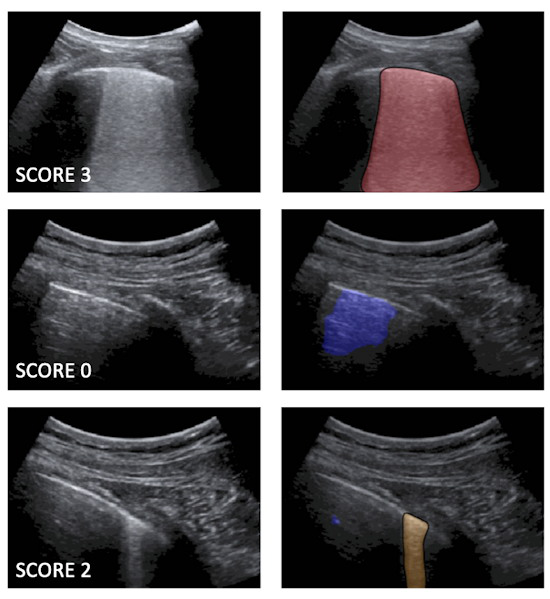
Examples of lung ultrasound images corresponding to score 3, score 0, and score 2
Left: Examples of lung ultrasound images corresponding to score 3 (top), score 0 (middle), and score 2 (bottom). Right: the corresponding semantic segmentations obtained with the described deep-learning algorithms. Color maps are informative of the score level (red for score 3, blue for score 0, orange for score 2), as well as indicate the relevant part of the image that determines the score. These maps explain the decision progress of the algorithms. Images and caption courtesy of Libertario Demi, PhD.

The algorithm's scores for each frame are then used to generate an aggregate score for each video. The researchers tested two methods for producing an aggregate score: one based only on the labeled video frames and another that combined the labeled frames with the segmented frames.

These video-level scores were then compared with the risk scores provided by expert clinicians.

AI algorithm performance for risk stratifying COVID-19 patients
 AI risk scores based on only labeled framesAI risk scores based on combination of labeled and segmented frames
Agreement with expert clinicians83.3%86%

Although the combined approach generally outperforms the first method, the improvement isn't significant. What's more, the first method seems more stable to threshold variations, according to the researchers.

"Therefore, the first approach can be considered as a self-standing strategy to classify [lung ultrasound] videos starting from a frame-based classification," the authors wrote. "Nevertheless, the semantic segmentation remains essential for clinicians, as it provides the explainability of the decision by highlighting the specific [lung ultrasound] patterns."

In future work, the researchers plan to expand their existing database and train deep-learning algorithms on video-labeled data instead of just frame-based labeled data. That approach would be more consistent with the process used by clinicians when evaluating lung ultrasound videos, they said.

How to implement POCUS at your hospital

By Amerigo Allegretto, AuntMinnie.com staff writer


June 1, 2021 -- So, you want to integrate point-of-care ultrasound (POCUS) into your hospital enterprise image network. But how? Breaking down what goes into a successful POCUS implementation was the subject of a May 26 talk at the Society for Imaging Informatics in Medicine meeting.


Successfully implementing POCUS requires swift strategy and teamwork, including taking advantage of existing imaging technology, according to registered nurse Laurie Perry from Cincinnati Children's Hospital in Ohio.

"Point-of-care ultrasound is only going to grow, and there will be divisions that continually need to be implemented. You'll need to do that quickly," she said.

POCUS has been looked at in recent years as a convenient clinical tool that can bring imaging to a patient's bedside. Advantages include portability and cost-effectiveness.

However, there are some limitations to POCUS, Perry said. One is that images remain on the ultrasound device and are not clinically available to anyone else taking care of the patient. POCUS images also can't be compared with other specialty images, and there are challenges to getting reimbursed.

Although many divisions at Cincinnati Children's Hospital wanted to use POCUS, Perry said they were unable to bill for the procedure until providers had been credentialed and images stored in the enterprise archive.

"If you're not storing images, you cannot bill for the ultrasound," Perry said.

To integrate POCUS with the rest of the enterprise, the implementation team needed to create a standard POCUS workflow within the electronic health record. Then, it needed to work with business managers to help them to understand the process for billing imaging studies.

The team that was assembled for this included clinical and business leaders from clinical divisions, imaging informatics professionals, electronic medical records analysts, a project manager, a trainer, and an enterprise imaging physician leader.

The group solved the existing challenges by working with clinical leaders and business managers in creating a process that fits into the existing workflow. Team members utilized ad-hoc order creation and automated as many steps as possible. They also worked with the radiology business director to identify and create appropriate procedure codes.

"All radiology and cardiology, including ultrasound, is sent to the hospital's enterprise archive. We've acquired and sent over 5,000 POCUS studies to the archive," Perry said. "We have billed more than $2.25 million of new services for our organization."

Children's Hospital began using POCUS for anesthesia in 2015 and has expanded its use in other care units and departments, such as emergency, pediatric intensive care, and cardiac intensive care among others. The hospital is currently working on implementing POCUS for physical medicine and rehab and its gastrointestinal division.

Perry said the hospital has used the following guiding principles over the years to successfully implement POCUS into its departments:

  • Take advantage of DICOM to power workflow.
  • Automate workflow for providers as much as possible.
  • Provide a link to the images in the electronic medical record, preferably within the appropriate context for the division.
  • The goal should be to create a standard, reproducible process.

Perry also said implementation teams should evaluate a division's current ultrasound machines for such things as WiFi capability, DICOM capability, and security requirements. Credentialing providers, as well as determining procedures and billing, developing the electronic medical record, and training users are also needed.

Thứ Bảy, 29 tháng 5, 2021

Special training not needed for COVID lung ultrasound scoring

By Amerigo Allegretto, AuntMinnie.com staff writer


May 26, 2021 -- Although there were some variations in performance, it may not be necessary for users of ultrasound scanners to receive special training before scoring lung exams of patients with COVID-19, according to research published May 21 in Nature.

group of researchers led by Dr. Markus Lerchbaumer from Charité Institute of Radiology in Berlin, Germany found that while different types of observers had "fair to moderate" interobserver agreement in interpreting specific lung findings in patients with COVID-19, a little background in lung ultrasound goes a long way.

"As long as observers have some experience in lung ultrasound, no specific clinical background is needed for scoring the findings, even though specific expertise is often reported as a requirement," the authors wrote.

Examining the lungs in patients is usually performed with nonenhanced CT scans, but point-of-care ultrasound (POCUS) is being looked at as a safer method since patients infected with the SARS-CoV-2 virus would not need to be transferred, and risk of exposure for medical staff would decrease.

The researchers said lung ultrasound may have a big advantage for COVID-19 due to its widespread availability and cost-effectiveness.

"Additionally, lung ultrasound has emerged over the last two decades as a noninvasive tool for the fast differential diagnosis of pulmonary diseases and is now used in different settings in intensive care," they wrote.

In the current study, 10 observers from three different medical specialties participated in rating 100 lung ultrasound images from 13 patients. These included observers specializing in intensive care medicine, emergency medicine, and physiology.

Images were acquired by a radiologist using a hand-held POCUS system (Viamo sv7, Canon Medical Systems) performed at the bedside. Ultrasound presets were optimized for lung ultrasound.

Through an online tool, observers could use multiple-choice options with predefined answers for rating the scans. Options included typical COVID-19-associated lung ultrasound findings; these included the following:

  • Pleural thickening and fragmentation
  • Presence of B-lines subclassified in single or confluent, subpleural consolidations
  • Positive air bronchogram

Selecting none of these pathologies was also an option.

The team found that observers in the intensive care unit tended to interpret B-lines more accurately, while physiology researchers and emergency physicians more often categorized B-lines as confluent rather than single. This tendency became even stronger over the course of viewing instances, probably explaining the poorer than expected overall inter- and intraobserver agreement.

"We assume that ICU observers have greater clinical experience with patients with severe ARDS or cardiogenic edema and their corresponding lung ultrasound findings, especially compared to scientists whose experience relies on lung ultrasound in rodents," they wrote.

ICU observers, on the other hand, differed from the latter two groups regarding the identification of pleural thickening.

Meanwhile, agreement was highest for more distinct lung ultrasound findings such as air bronchograms and subpleural consolidations, as well as more severe lung ultrasound scores.

The researchers wrote that training lung ultrasound users may improve agreement and clinical feasibility. They also suggest that training material used for lung ultrasound in POCUS should pay better attention to areas such as B-line quantification and differentiation of intermediate scores, which revealed only "mediocre" agreement in the study.

Thứ Tư, 26 tháng 5, 2021

US AI model can help evaluate chronic kidney disease


By Erik L. Ridley, AuntMinnie.com staff writer

May 24, 2021 -- Artificial intelligence (AI)-based analysis of kidney ultrasound studies could serve as a first-line method for evaluating patients with chronic kidney disease, according to research published online May 24 in JAMA Network Open.


team of researchers led by Dr. Ambarish Athavale of Cook County Health in Chicago developed a deep-learning algorithm that yielded approximately 90% accuracy on a test set for quantifying interstitial fibrosis and tubular atrophy (IFTA).

"This article provides proof-of-principle that a [deep-learning] system can be used to noninvasively, accurately, and independently predict IFTA grade in patients with kidney disease," the authors wrote. "Although the system in its current form may not be an alternative to kidney biopsy, after robust external validation, a [deep learning]-based, noninvasive assessment of IFTA has the potential to significantly enhance clinical decision-making and prognostication in patients with CKD."

A strong indicator for decline in kidney function, interstitial fibrosis and tubular atrophy is currently measured using histopathological assessment of a kidney biopsy core. There currently isn't a noninvasive test for IFTA, according to the researchers.

The authors utilized AI to test their hypothesis that subtle signs of IFTA are ingrained within kidney ultrasound images and could be quantitatively extracted and analyzed. A deep-learning algorithm was trained and tested to segment the kidney and classify IFTA using 6,135 consecutive Crimmins-filtered kidney ultrasound images acquired at their institution between January 1, 2014, and December 31, 2018. The longitudinal images were obtained from both kidneys and were acquired between six months before and two weeks after kidney biopsy.

Of the total image dataset, 5,122 were used for training and 401 were used for validation. The researchers then tested the model on 612 images. The algorithm was 91% accurate for segmenting the kidney ultrasound images.

Performance of AI algorithm for quantifying IFTA on kidney ultrasound
 Image levelPatient level
Precision0.8930.900
Recall0.8040.842
Accuracy0.8680.896
F1 score0.8390.864

In other results, the researchers noted that the algorithm's accuracy remained high irrespective of the timing of the ultrasound studies and the biopsy diagnosis. Also, adding baseline clinical characteristics into the model's analysis didn't significantly improve its performance.

"From a clinical standpoint, it is foreseeable that a [deep-learning] system such as the one developed in this study has the potential to act as a gatekeeper for rationalizing the decision to conduct a kidney biopsy in patients with CKD," the authors wrote. "We anticipate that because of the ability of this system to provide [a] probabilistic estimate of IFTA in real-time, the system is likely to be acceptable (because it is unlikely to put any time burden on the technicians) and can also reduce the costs associated with kidney biopsy."

The researchers acknowledged that more work is needed to improve the accuracy of the model before it's ready for clinical use. Furthermore, the algorithm needs to be validated on external datasets to assess its performance across varying clinical settings.

Thứ Tư, 19 tháng 5, 2021

REVERBERATION ARTEFACTS IN LUNG US, WFUMB POSITION PAPER


Abstract
The analysis of vertical reverberation artefacts is an essential component of the differential diagnosis in pulmonary ultrasound. Traditionally, they are often, but not exclusively, called B-line artefacts (BLA) and/or comet tail artefacts (CTA), but this view is misleading.
In this position paper we clarify the terminology and relation of the two lung reverberation artefacts BLA and CTA to specifc clinical scenarios. BLA are defned by a normal pleura line and are a typical hallmark of cardiogenic pulmonary edema after exclusion of certain pathologies including pneumonia or lung contusion, whereas CTAs show an irregular pleura line representing a variety of parenchymal lung diseases. The dual approach using low frequency transducers to determine BLA and high frequency transducer to determine the pleural surface is recommended.

Keywords: lung ultrasound; artefact; B-lines; comet tails; guidelines; misdiagnosis


Suggested approach:

The transducer should be positioned such that the emenating ultrasound beam perpendicularly intersects
the surface of the lung to maximize likelihood of seeing all BLA and CLA as well as A line artifacts (fig 1).
A recent study highlighted the potentially detrimental effects of placing the focal zone below the pleural line,using spatial compounding, higher frequency and tissue harmonics [14]. Once machine settings and transducer orientation have been optimized, we suggest that two most important and distinct vertical lung artefacts should be differentiated: BLA and CTA. While true BLA (fig 2) originate from a smooth pleural reflex due to cardiogenic pulmonary edema and present in a diffuse pattern, CTAs are seen in many lung disorders with irregular and fragmented pleural reflexes and can be focal or diffuse (fig 3).
Hence, the initial step should be to determine if there is evidence for diffuse pulmonary disease or defned focal or localized pathology. Focal lung pathologies by defnition should display vertical artifacts that are consistent with CTAs (fig 4).
Diffusely distributed vertical reverberation artefacts can be divided into two groups: with or without detectable pleural line irregularities and with stable or distally widening width:

1. The reverberation artefact (evaluated by low frequency transducer <5 MHz without interfering presets) is called
BLA if arising from a smooth pleural line (evaluated by high frequency transducer ≥10 MHz). The BLA arises from edema within the interstitium, is well defned with stable width, hyperechoic and extending indefnitely (the entire depth, at least 10 cm), erasing A-lines and moving with lung sliding. It is important to realize that many modern ultrasound machines have post-processing and other features which will eliminate not only BLA but essentially all discernable image detail near the bottom of the screen at greater depths (fig 5).
2. The reverberation artefact is called CTA if arising from an irregular (or fragmented) pleural line (evaluated by high frequency transducer ≥10 MHz), changes in width (such as e a comet with narrow head and wide tail), is well defned, hyperechoic, and extending defnitely (<10 cm in depth) (evaluated by low frequency transducer <5 MHz without interfering presets). It is important to make sure image compounding is turned off to make sure the CTA is not distorted farther field [14].
The differentiation of BLA from CTA is also dependent on the technical adjustments of several external factors, including the type of ultrasound machine, transducers and probe frequencies [6].


In conclusion, the correct diagnosis of pulmonary edema (the etiology of which may be decided upon
through integration of ultrasound data with clinical presentation) in the emergency setting is crucial for the correct management of the patient. The differentiation between ultrasonographic BLA and CTA, using two types (high and low frequency) of transducers allows accurate differentiation between pulmonary edema and other cause of diffuse pulmonary pathology. Both can lead to acute respiratory failure but may require different clinical management. Localized pulmonary diseases representing with CTA are distinguished. Mixed forms of diffuse,but also diffuse and focal lung diseases have to be considered.


Thứ Hai, 10 tháng 5, 2021

US accurate in diagnosing hand injuries

By Amerigo Allegretto, AuntMinnie.com staff writer


May 10, 2021 -- Ultrasound can accurately diagnose hand injuries while also being a fast, inexpensive, and potentially indispensable dynamic tool, according to research published April 29 in Ultrasound in Medicine and Biology.

Examining hand tendon injuries with sonography showed 100% accuracy, sensitivity, and specificity for diagnosing full-thickness hand tendon tears, as well as tenosynovitis of hand flexor tendons, according to a study led by Dr. Chris Nabil Hanna Bekhet from Ain Shams University in Cairo, Egypt.

"It also provides data that are important before diagnostic surgical exploration, and the process consumes less time than traditional wound exploration techniques or MRI," the authors wrote.

Hand and wrist injuries make up 28% of all musculoskeletal injuries and account for 14% to 30% of all patients treated in the emergency department. Tendon injuries are the second most common injuries, within injuries to the flexor tendons having debilitating consequences and high rates of reoperation.

Assessing hand injuries through clinical examination can overlook tendon injuries, and surgeons sometimes opt for explorative surgical methods to detect tendon injuries.

While using ultrasound to examine tendon injuries in the emergency department has its advantages, including eliminating the need for surgical approaches, it is not yet readily adopted by surgeons. This could be because clinicians lack education on how to use ultrasound to resolve clinical questions on the state of the tendon.

The study included 35 patients between September 2018 and January 2020 with trauma to the ventral surface of the hand and wrist who were presented to emergency departments or outpatient clinics. The subjects ranged from 18 to 58 years of age, with 24 patients being male and the other 11 being female.

The researchers examined 50 injured tendons in all flexor hand zones.

On ultrasound examination, 21 of the 50 injured tendons were reported to have complete tears, and 10 tendons were partially torn. The most common cause of injury was cut wounds by sharp objects (20 cases), with injury by a knife as the highest incidence.

In all, ultrasound was found to be statistically significant (p < 0.01) in predicting the surgical findings by correctly identifying the 21 fully lacerated tendons. It was also found to be statistically significant (p < 0.01) in predicting the surgical findings by correctly identifying partially torn tendons and determining the degree of the torn fibers.

The study's limitations included tests being performed by a single operating radiologist and the small sample size.

"More studies in this respect can popularize the technique among radiologists and clinicians," the authors wrote. "Our study also helps anchor the notion that musculoskeletal [ultrasound] could be widely employed for soft tissue structures, with their well-recognized advantages compared with other imaging techniques."

Thứ Tư, 5 tháng 5, 2021

Sonographer vs. radiologist: What does it make?


May 4, 2021 -- The clinical outcomes of children presenting with suspected acute appendicitis were similar regardless of whether they were scanned by sonographers or radiologists, according to research published April 29 in the Journal of the American College of Radiology.

In a study led by Dr. Leah Gilligan from Northwestern University in Illinois, researchers found that differences between radiologists and sonographers did not lead to clinically important outcomes in children undergoing ultrasound for suspected acute appendicitis. This also includes hospital readmission, surgical consultation, and appendectomy performance.

The team noted that this could also be because clinical care pathways could be sufficiently robust and that deviations in the performance of sonographers or radiologists are corrected by redundant safety nets.

"In other words, although sonographers and radiologists are known to vary in performance and interpretation skill, those differences do not seem to translate into meaningful differences in major clinical care outcomes for this indication," Gilligan colleagues wrote.

The team analyzed 9,283 appendix ultrasound scans with a mean patient age of 9.9 years; 58.2% of the patients were boys. For the study, ultrasound scans were performed by 31 sonographers and interpreted by another 31 radiologists.

The group found no statistically significant difference in outcomes between sonographers and radiologists. For example, children had the same appendectomy rate (20.3%) for both sonographers and radiologists, while the hospital admission frequency was also similar: 34% for sonographers and 33.5% for radiologists.

Despite the differences between sonographers and radiologists not being statistically significant, numerous other clinical and system factors do seem to be associated with these outcomes, the researchers found. Some of these were anticipated, such as ultrasound report impression, degree of abdominal tenderness, and white blood cell count.

One unanticipated factor that researchers noted was whether or not imaging was performed at the main hospital versus a satellite hospital.

They found that presentation to the satellite emergency department was associated with a decreased odds of hospital admission and surgical consultation, as well as an increased odds of hospital readmission within 30 days after adjusting for numerous clinical variables and system factors. The satellite hospital is staffed by the same sonographers and radiologists that work at the main hospital.

"As our study was not primarily designed to specifically investigate the impact of the location of imaging, the exact cause of these differences is unknown," they said.

The team also showed that assessing differences "probably" should not be used as a meaningful quality indicator in radiology department members performing and interpreting appendix ultrasound.

These results are potentially important because appendix ultrasound is widely performed and is a first-line test for suspected appendicitis at most dedicated pediatric hospitals, Gilligan and et al wrote.

AI can help to classify masses found on breast ultrasound


By Erik L. Ridley, AuntMinnie.com staff writer

May 3, 2021 -- Artificial intelligence (AI) software can aid radiologists in characterizing masses on screening breast ultrasound exams by improving cancer detection and reducing false positives, according to research from Yale University.

A research team led by Dr. Liane Philpotts retrospectively compared the performance of a commercial AI software algorithm with the original interpreting radiologist on over 200 lesions found on breast ultrasound. The group found that the software would have correctly classified all malignant cases and downgraded many lesions deemed initially to be suspicious.

"AI software appears to be a complementary tool for radiologists," Philpotts said during a presentation at the recent annual meeting of the American Roentgen Ray Society (ARRS). "Utilization of an AI decision support tool for whole-breast ultrasound findings could result in shifts away from the BI-RADS 3 category with the potential to increase the percentage of lesions characterized as benign, therefore increasing the sensitivity for malignant lesions."

Whole-breast screening ultrasound is becoming more commonplace across the U.S. and around the world, Philpotts said. Many states have passed laws regarding the notification of women with dense breasts, and in 2019, the U.S. Food and Drug Administration proposed national changes to the Mammography Quality Standards Act (MQSA) to require that women be notified of their breast density status.

"While these changes have increased the utilization of whole-breast screening ultrasound, the management of incidental solid masses found during these examinations is not well established," Philpotts added.

In their study, the researchers sought to establish a baseline performance for radiologists managing these masses and to determine whether an AI system -- Koios DS for Breast from Koios Medical -- could be used to improve diagnostic accuracy, Philpotts said. Lev Barinov, PhD, of Koios was also a co-author on the study.

Although the software is intended for use as an adjunct during radiologist interpretation, the researchers wanted to evaluate its theoretical benefit by retrospectively and independently assessing its potential impact, if any, on lesion management recommendations, Philpotts said.

"This type of analysis allows us to begin to set the bounds on the impact such systems will have on the interpretation of ultrasound studies," she said.

The researchers gathered cases from October 1, 2017, to September 30, 2018, of women with dense breasts that were interpreted as negative on digital breast tomosynthesis and who subsequently received whole-breast screening ultrasound. A total of 206 lesions of BI-RADS 3 or higher from 206 patients were included in the analysis. For the purposes of the study, ground truth was established via pathological results or an average of 15 months follow-up.

Of the 206 lesions, 162 were diagnosed as BI-RADS 3 (probably benign) by the radiologist and 44 were deemed to be BI-RADS 4 (suspicious). There were seven malignant lesions, two of which were classified by the original interpreting radiologist as BI-RADS 3 and five of which were categorized as BI-RADS 4. The remaining 109 lesions were benign. 

All identified lesions were anonymized and annotated with regions of interest by dedicated breast imagers in two orthogonal planes. The AI software then processed the two orthogonal B-mode views of each lesion to generate a likelihood of malignancy -- benign, probably benign, suspicious, and probably malignant -- that aligned to BI-RADS categories 2-5.

Each software assessment category can then be further subdivided by a confidence level indicator, which displays where within each risk category the lesion falls and provides a continuous probability of malignancy that can be used for subsequent data analysis, Philpotts noted.

Of the BI-RADS 3 lesions in the study that were actually benign, the AI software would have downgraded 41% to BI-RADS 2 and upgraded 32% to BI-RADS 4. The remaining 27% remained as BI-RADS 3. The software identified all malignant lesions, including the two lesions originally categorized as BI-RADS 3 by the initial interpreting radiologist.

Performance of AI software on assessing masses on screening breast ultrasound
 RadiologistsAI software
Sensitivity71.4%100%
Area under the curve0.790.89

Larger and prospective studies will be needed, however, to assess how the software integrates into clinical workflow and influences patient management, according to Philpotts. 

She acknowledged the limitations of their study, including its use of only B-mode lesions. In addition, the group only examined the software's standalone output and didn't evaluate joint physician/AI decision-making.

"Additional clinical information, mammographic findings, or Doppler diagnostic evaluation would [also] be incorporated by radiologists when using the AI software in actual clinical practice," she said.