Tổng số lượt xem trang

Chủ Nhật, 14 tháng 4, 2019

ML for US


https://www.ncbi.nlm.nih.gov/pmc/articles/PMC5886811/

Abstract

Ultrasound (US) imaging is the most commonly performed cross-sectional diagnostic imaging modality in the practice of medicine. It is low-cost, non-ionizing, portable, and capable of real-time image acquisition and display. US is a rapidly evolving technology with significant challenges and opportunities. Challenges include high inter- and intra-operator variability and limited image quality control. Tremendous opportunities have arisen in the last decade as a result of exponential growth in available computational power coupled with progressive miniaturization of US devices. As US devices become smaller, enhanced computational capability can contribute significantly to decreasing variability through advanced image processing. In this paper, we review leading machine learning (ML) approaches and research directions in US, with an emphasis on recent ML advances.


We also present our outlook on future opportunities for ML
techniques to further improve clinical workflow and US-based disease diagnosis and characterization.

Keywords: Deep Learning, Elastography, Machine Learning, Medical Ultrasound, Sonography

Thứ Ba, 9 tháng 4, 2019

QUANTITATIVE ULTRASOUND [Q U S], EMERGING MODE for CLINICAL ULTRASOUND

By Kate Madden Yee, AuntMinnie.com staff writer
April 8, 2019 -- ORLANDO, FL - Quantitative ultrasound (QUS) shows promise as an emerging mode for clinical ultrasound, offering more specific data compared with conventional ultrasound exams, according to a lecture delivered Monday at the American Institute of Ultrasound in Medicine (AIUM) meeting.

Many conventional ultrasound studies already offer quantitative information, including distance, area, and volume measurements; Doppler-generated velocities and volume flow estimates; cardiac wall motion, strain, and ejection fraction data; and contrast and tissue stiffness analysis. But conventional ultrasound is subject to operator variability, said James Zagzebski, PhD, of the University of Wisconsin in Madison.
"QUS uses bulk acoustic properties and tissue microstructure features to increase ultrasound's sensitivity and specificity," he said during the AIUM's William J. Fry Memorial Lecture. "I believe that the current computational resources on ultrasound systems can be further exploited to provide us even more data than we already have."
QUS technology has continued to advance, replacing conventional ultrasound's beamformer technology with high-capacity computational hardware and software, and synthesized virtual beams, Zagzebski said. Compared with conventional ultrasound, QUS imaging offers more data related to tissue features -- such as attenuation and backscatter coefficients -- that increase the specificity of image findings and can lead to improvements in diagnostic ultrasound. QUS techniques include spectral-based parameterization, elastography, shear-wave imaging, and flow estimation.
"System independent backscatter coefficient and attenuation coefficient estimates can be made accurately using clinical scanners," he told session attendees. "There's evidence that QUS can provide valuable information to assess diffuse liver disease, characterize breast masses, and assess the effects of anesthesia."
QUS may be particularly helpful for breast imaging, according to Zagzebski.
"In vitro studies showed that QUS parameters, attenuation coefficient, and backscatter coefficient can give useful insight into the nature of breast tissue," he said. "And animal studies have shown that the use of QUS parameters such as effective scatter [can] differentiate benign fibroadenomas from malignant breast masses."
Other potential applications for QUS include evaluating changes in the cervix accompanying ripening and breast tumor response to treatment, tracking lymph node involvement in disease, monitoring radiofrequency and microwave ablation, and diagnosing eye and orbital disease, Zagzebski noted.
In any case, as the use of QUS continues, there's a need to set best practices, such as those established through the Quantitative Imaging Biomarkers Alliance (QIBA), he said.

"We need to establish good protocols for QUS, like those developed through the QIBA effort, so that everybody will be operating under the same standards," he concluded.

QUANTITATIVE ULTRASOUND IMAGING

https://www.aapm.org/meetings/amos2/pdf/59-17304-58800-911.pdf


Thứ Sáu, 5 tháng 4, 2019

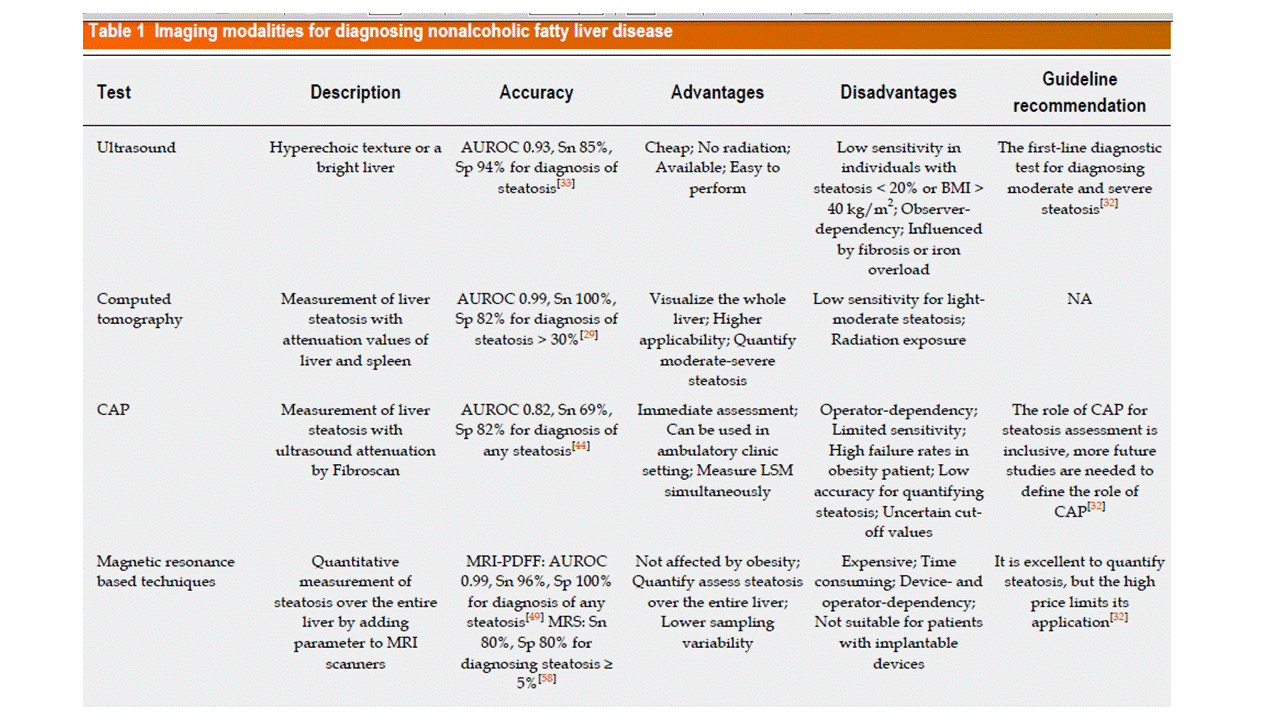
Noninvasive Evaluation of NAFLD: CURRENT EVIDENCE and PRACTICE


FATTY LIVER - CHRONIC B HEPATITIS and H C C


Researchers test new ultrasound method for heart disease


April 5, 2019 -- Researchers from the University of Arkansas in Fayetteville have published results from a study testing a new ultrasound imaging method for the detection and diagnosis of congenital heart disease in infants and children.
The new technology, called vector flow, creates images of the internal structure and blood flow of children's hearts. It was used for the first time in humans at the Arkansas Children's Hospital in Little Rock, according to a team led by Dr. Morten Jensen, PhD. The study was published March 5 in Progress in Pediatric Cardiology.
About 1% of babies are born with congenital heart defects. Pediatric cardiologists identify congenital heart disease using echocardiography and other processes based on ultrasound, the researchers wrote. Although effective, ultrasound can't accurately obtain details about blood flow within the heart.
The team used an ultrasound scanner with vector flow imaging to image the hearts of two three-month-old babies, one with a healthy heart and one with congenital heart disease. The technology allowed for complete transthoracic imaging of tissue and blood flow at a depth of 6.5 cm; abnormal flow and cardiac anomalies were clearly visualized in the child with congenital heart disease.
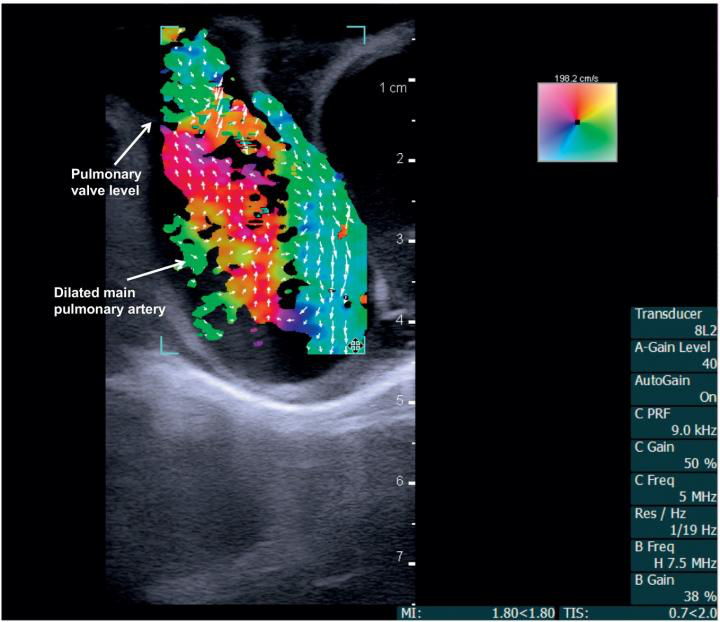
Vector flow imaging demonstrates swirl of blood flow within the dilated main pulmonary artery of a pig.
Vector flow imaging demonstrates swirl of blood flow within the dilated main pulmonary artery of a pig. Image courtesy of Dr. Morten Jensen, PhD.
"Vector flow imaging technology is not yet possible in adults, but we have demonstrated that it is feasible in pediatric patients," Jensen said in a statement released by the university April 3. "Our group demonstrated that this commercially available technology can be used as a bedside imaging method, providing advanced detail of blood flow patterns within cardiac chambers, across valves, and in the great arteries."