Tổng số lượt xem trang

Thứ Sáu, 24 tháng 7, 2020

A New Standardize Doppler waveform reporting


By Theresa Pablos, AuntMinnie staff writerJuly 24, 2020 -- A new set of guidelines aims to standardize the terminology used to report arterial and venous spectral Doppler ultrasound waveforms. The document was jointly published on July 15 in Vascular Medicine and the Journal for Vascular Ultrasound.

The statement creates a designated set of key terms to describe findings on spectral Doppler ultrasound waveforms, the main diagnostic assessment for arterial and venous diseases. It was written by sonographers, vascular specialists, and other experts commissioned by the Society of Vascular Medicine and Society of Vascular Ultrasound.
"The hope of the writing committee is that this document will help us all to 'speak the same language,' and thereby advance the field of vascular ultrasound and improve patient care," stated lead study author Dr. Esther Kim, vascular labs medical director at Vanderbilt University Medical Center, in a press release.
The lack of shared nomenclature has been an ongoing problem for vascular ultrasound professionals. In fact, one out of five ultrasound professionals has had to perform a repeat arterial Doppler ultrasound examination because of terminology differences, according to a survey cited in the consensus statement.
"Over a decade ago, the lack of a standardized nomenclature to describe spectral Doppler waveforms was demonstrated to result in confusion amongst ultrasound professionals," Kim stated. "Not surprisingly, this can lead to negative clinical outcomes."
In the consensus statement, the committee established three major descriptors for ultrasound waveforms: flow direction, phasicity, and resistance for arterial waveforms and flow direction, flow pattern, and spontaneity for venous waveforms.

Major descriptors for arterial ultrasound waveforms
Flow directionAntegrade
  • Blood flows in normal direction
  • Previously known as forward flow
Retrograde
  • Blood flows in opposite direction
  • Previously known as reverse flow
Bidirectional
  • Blood enters and leaves through the same opening
  • Previously known as to-fro
Absent
  • No detected blood flow
PhasicityMultiphasic
  • Waveform crosses zero-flow baseline
  • Previously known as triphasic or biphasic
Monophasic
  • Waveform does not cross zero-flow baseline
  • Blood flows in single direction
ResistanceHigh resistive
  • Sharp upstroke and brisk downstroke
Intermediate resistive
  • Visible end-systolic notch
  • Continuous flow above the zero-flow baseline
Low resistive
  • No end-systolic notch
  • Prolonged downstroke in late systole

Major descriptors for venous ultrasound waveforms
Flow directionAntegrade
  • Blood flows in normal direction
  • Previously known as central or forward flow
Retrograde
  • Blood flows in opposite direction
  • Previously known as peripheral or reverse flow
Absent
  • No detected blood flow
Flow patternRespirophasic
  • Flow velocity related to respiratory cycle
  • Previously known as respiratory phasicity
Decreased
  • Respirophasic flow with less variation than expected
  • Previously known as dampened or blunted
Pulsative
  • Flow velocity is inversely linked to cardiac cycle
  • Previously known as cardiophasic
Continuous
  • Respiratory/cardiac cycles do not affect flow velocity
  • Steady Doppler signal with minimal variation
Regurgitant
  • Flow velocity varies with cardiac cycle
SpontaneitySpontaneous
  • Blood flows without external influence
Nonspontaneous
  • Blood flows only with external maneuvers
The statement also established terms that can be used to modify the main descriptors. For arterial waveforms, the seven modifying terms are as follows:
  1. Rapid upstroke -- Near vertical rise to peak systole
  2. Prolonged upstroke -- Abnormally gradual slope to peak systole; previously known as tardus, delayed, or damped upstroke
  3. Sharp peak -- Single, well-defined peak
  4. Spectral broadening -- Widening of the velocity band or filling in the typically clear area under the systolic peak; previously known as nonlaminar, turbulent, disordered, or chaotic
  5. Staccato -- High-resistance pattern with a short, low-amplitude diastolic signal punctuated by spikes of acceleration and deceleration
  6. Dampened -- Abnormal upstroke and peak, typically with decreased velocity; previously known as parvus et tardus, attenuated, or blunted
  7. Flow reversal -- Flow that changes direction but not as part of normal flow, can be transient or consistent with the cardiac cycle; previously known as pre-steal, competitive flow, or oscillating
For venous waveforms, the three modifying terms as follows:
  1. Augmentation -- Changes in flow velocity related to physical maneuvers, can be described as normal, reduced, or absent augmentation
  2. Reflux -- Persistent retrograde flow beyond normal closure time
  3. Fistula flow -- Flow with an arteriovenous fistula that becomes pulsatile due to communication with artery, sharp peaks often appear as pulsatile; previously known as arterialized or fistulous
In addition to creating the key descriptors and modifiers, the statement defined the reference baseline for spectral Doppler waveforms as the zero-flow baseline. It also advised against using the terms "normal" or "abnormal" to describe a waveform, since what is normal will depend on the part of the body and situation.
The statement also instructed sonographers to use image optimization techniques to acquire quality Doppler waveforms. This includes using an optimal transducer-to-vessel angle, the normal peripheral artery systolic waveform acceleration of 0.2 seconds, and proper transducer support.
Finally, the committee advised sonographers to provide complete descriptions for referring providers, including indication, relevant history, velocity measurements, and waveform characteristics. Sonographers should also include a conclusion with the clinical indication.
"We hope that this new Doppler waveform nomenclature will eliminate confusion and lead to appropriate diagnosis and better patient care," stated Dr. Raghu Kolluri, president of the Society of Vascular Medicine.

Thứ Sáu, 17 tháng 7, 2020

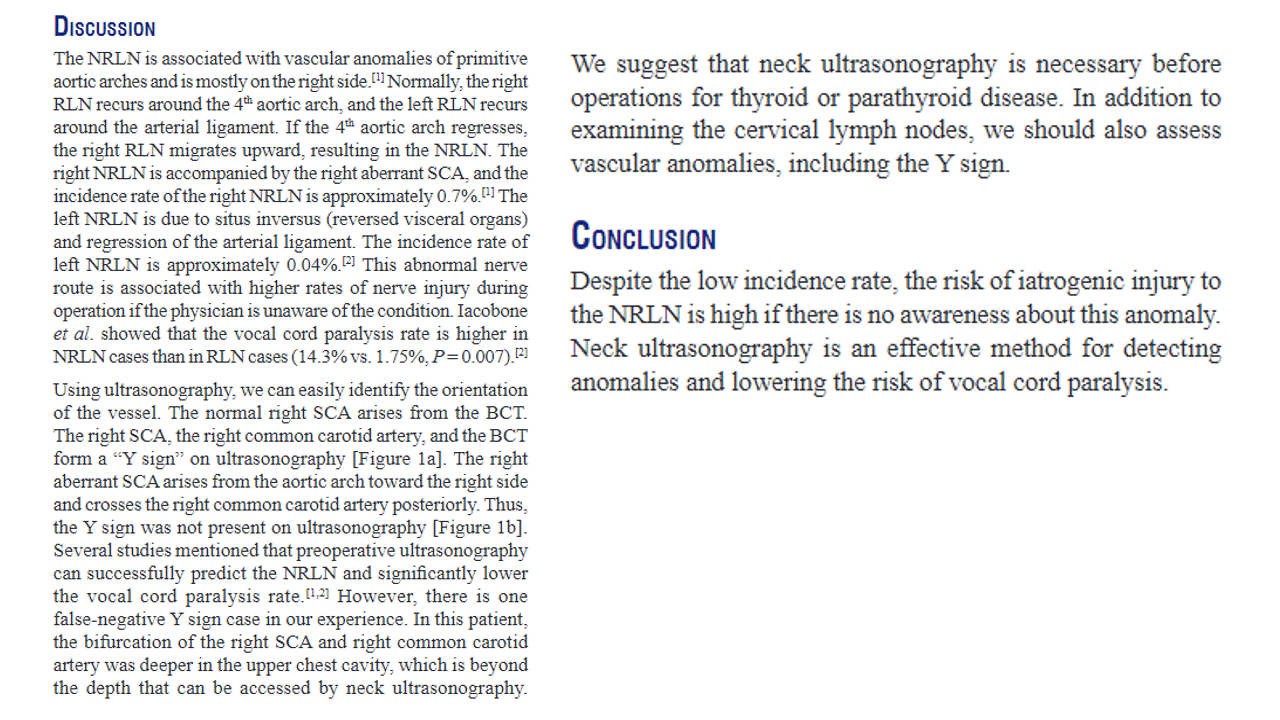
NEGATIVE Y SIGN=NONRECURRENT LARYNGEAL NERVE


POCUS Findings can Predict COVID-19 Death Risk


By Theresa Pablos, AuntMinnie staff writer
July 17, 2020 -- The findings on initial lung scans with point-of-care ultrasound (POCUS) can predict which patients with COVID-19 are at a greater risk of death, according to a prospective study from Italy published on July 15 in Ultrasound in Medicine & Biology.
Physicians in Rome performed lung ultrasound scans on 41 adult patients who visited a tertiary emergency department with symptoms of the novel coronavirus disease. Patients who later died or were later admitted to the intensive care unit (ICU) had significantly worse pathological findings on their initial scan.
"Our study shows that [lung ultrasound scan] is able to detect COVID-19 pneumonia and to predict, during the first evaluation in the emergency department, patients at risk of intensive care unit admission and death," wrote the authors, led by Nicola Bonadia, from the department of emergency medicine at Agostino Gemelli University Policlinic.
Physicians performed point-of-care ultrasound (POCUS) scans on all patients with suspected cases of COVID-19 who visited the emergency department in March. The emergency department staff used a pocket device with a wireless 6-MHz convex probe and followed a previously described lung ultrasound protocol that includes 14 chest areas.
Each scanned area received a numeric score of 0 to 3 based on the severity of the findings in that section. A higher lung ultrasound score (LUS) signified worse disease severity, with a score of 3 indicating dense or large areas of white lung with or without subpleural consolidations.
The authors analyzed the lung ultrasound findings from 41 patients with a positive SARS-CoV-2 test result and known outcomes. They specifically excluded children and patients with less than six months life expectancy due to preexisting chronic conditions, such as advanced cancer or dementia.
More than 90% of adult patients with COVID-19 had at least one area with an abnormal lung ultrasound finding. Pathological findings occurred in all 14 scanned areas but were most prominent in the lateral lung regions, the authors noted.
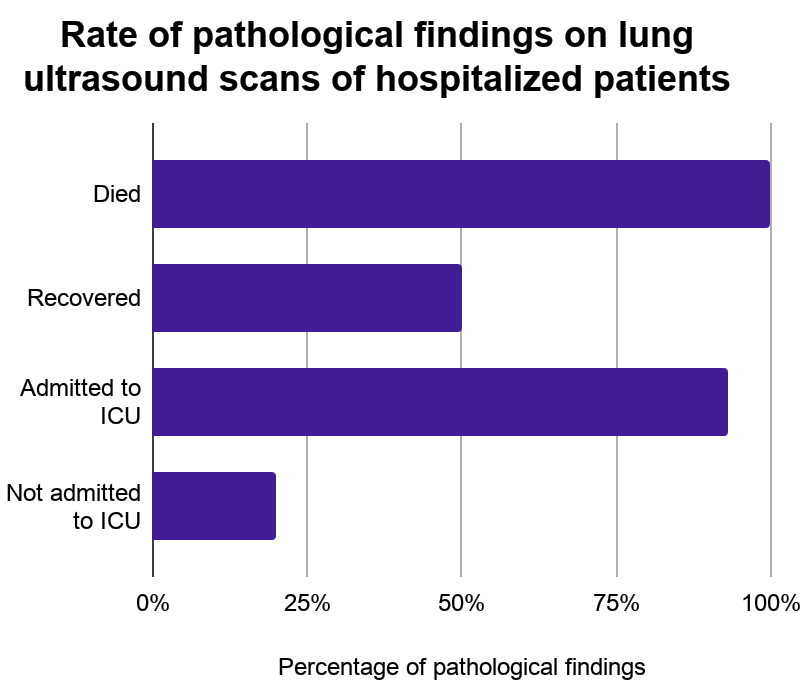
radiology graph
Patients with fatal cases of COVID-19 had pathological findings in 100% of scanned areas, compared with just 50% of scanned areas in discharged patients. These patients also had a mean lung ultrasound score of 1.43, compared with 1.0 in discharged cases.
Similarly, patients admitted to the ICU had pathological findings in 93% of scanned areas, compared with just 20% of areas in patients not admitted to the ICU. ICU patients also had a mean LUS of 1.36, compared with 1.0 in non-ICU patients.
Based on their findings, the authors determined the cutoff for a strict definition of COVID-19 pneumonia should be an LUS of 0.4 and a pathological findings rate of at least 20%. Furthermore, no study participants died if they had a mean LUS less than 1.1 and an average pathological rate under 70%.
The authors cautioned their study took place at one institution and had a small sample size. Nevertheless, the findings may help health professionals better triage patients with COVID-19 and spur future studies to evaluate whether lung ultrasound scores can guide patient treatment and admission decisions.
"We found a significant correlation between ultrasound findings and severity of the disease, assessed as mortality and need for ICU admission," the authors wrote. "To our knowledge, this is the first study describing the predictive role of LUS in patients with COVID-19."

Thứ Tư, 8 tháng 7, 2020

US SWE ở trẻ em


In fact, for pSWE and 2D-SWE experience in B-mode US is mandatory. Data acquisition should be undertaken by specialists. Operators experienced both in ultrasonography and elastography are needed to obtain reliable liver stiffness measurements in children, considering the different anatomy, especially in babies (liver situated lower in the abdomen), and the fact that cooperation from a small child is sometimes difficult. The location for measurements can be more difficult to establish in children and here the operator’s experience can play a role.


Neonatal brainSome early reports on the use of transcranial SWE of the periventricular brain parenchyma, in preterm infants and infants with hydrocephalus, suggest that SWE is possible and technically feasible [101,102] (fg 5, fg 6).
Albayrak et al showed that differences between brain stiffness values in preterm and term neonates can be demonstrated by using 2D-SWE. Brain stiffness measured from both the thalamus and periventricular white matter were found to be signifcantly lower in preterm neonates compared with term neonates (cut-off values for determining prematurity less than 8.28 kPa for mean
thalamus stiffness and less than 6.59 kPa for periventricular white matter stiffness). The authors suggested that the results might be reference points for evaluating neonatal brain stiffness in research on patients with various illnesses. 2D-SWE also seems to have the ability to depict increased intracranial pressure (ICP) in infants, with a positive linear correlation between SWE values and ICP
[102]. Infants with ICP seem to have increased 2D-SWE values (mean 24.2±5.1 kPa) compared to healthy infants (mean 14.1±6.6 kPa). However, larger prospective studies are still not available. If these preliminary observations of the benefts of transcranial SWE of the neonatal brain will be confrmed by further studies, SWE might be a useful method for additional diagnostic imaging and
monitoring in premature infants and children with proven or suspected increased ICP. When performing SWE of the neonatal brain, potential risks and harms of applying high energy levels by US to the neonatal brain should be considered. Recently, an experimental study on mice dealing with the potential biological effects associated with 2D-SWE on the neonatal brain was published [103].
The results indicated that 2D-SWE does not cause detectable histologic changes in the brain of neonatal mice, nor does it have long-term effects on the learning and memory abilities. However, some temporary effects were observed when the scanning lasted for more than 30 min. Thus, it is recommended to pay attention to the scanning duration when assessing neonatal brains with 2D-     SWE elastography.
  
The examiner should acquire appropriate knowledge and training in US elastography [104,105]. The operator Fig 5. SWE of the neonatal brain in a healthy newborn (14 days old). Sagittal view of the periventricular region in a healthy newborn. B-mode shows no abnormalities 
(a). 2D-SWE shows a mean periventricular tissue stiffness of 13.5 kPa and a maximum value of 14.8 kPa 
(b). must distinguish a good B mode US image from suboptimal images.