Tổng số lượt xem trang

Thứ Bảy, 26 tháng 9, 2020

Pocket-sized ultrasound delivers big results for COVID

By Theresa Pablos, AuntMinnie staff writer


September 25, 2020 -- A pocket-sized ultrasound scanner powered by a smartphone performed comparably to a cart-based scanner for lung imaging at the point of care in patients with COVID-19, according to a study published on September 21 in Ultrasound in Medicine and Biology.

In the head-to-head study, a team of Italian authors compared a conventional, portable cart-based ultrasound scanner with a pocket-sized device for point-of-care ultrasound (POCUS) of COVID-19 patients. The smaller -- and cheaper -- system adequately visualized pulmonary regions of patients with COVID-19.

The findings are good news in a pandemic rife with medical equipment shortages.

"Our study confirms the possibilities of portable pocket-sized ultrasound imaging of the lung in COVID-19 patients," wrote the authors, led by Dr. David Bennett from the University Hospital of Siena in Siena, Italy.

Lung ultrasound has repeatedly proved its usefulness as a tool to diagnose and monitor patients with COVID-19. While prior studies on the topic have used portable ultrasound systems, no research has directly compared the performance of pocket-sized ultrasound systems with larger scanners for COVID-19 imaging.

In the latest study, clinicians performed lung ultrasound scans on 18 patients hospitalized with COVID-19 at the University Hospital of Siena. The patients were all symptomatic, tested positive for SARS-CoV-2, and had radiologic evidence of interstitial pneumonia.

Clinicians scanned the patients using two ultrasound systems: (1) Venue Go by GE Healthcare, a cart-based system with built-in artificial intelligence capabilities, and (2) Butterfly iQ by Butterfly Network, a pocket-sized system powered by a smartphone that uses a silicon chip instead of a piezoelectric crystal.

The team used the scans to calculate patients' lung ultrasound scores, a proven method for quantifying pulmonary disease severity in patients with COVID-19. The scoring system works by assigning numerical scores of 0-3 to unique lung regions. Higher scores indicate worse disease severity.

The team found no significant difference between the two systems for patients' overall lung ultrasound scores. Lung scores obtained by both systems also correlated with patients' clinical severity.

In addition, the scores were comparable for most individual pulmonary regions, including the left and right side and vertical location. However, the team did find an 0.082 score difference between the systems for horizontal position, a statistically significant finding they deemed a "practically negligible difference in the posterior side of the thorax."

Further statistical analysis revealed a bias of -0.016 between the systems with very narrow limits of agreement.

"The results of the portable scanner were practically identical to the high-end scanner in the assessment of lung interstitial syndrome," the authors wrote.

While pocket-sized scanners are easy to carry and significantly cheaper than larger models, they also come with a number of drawbacks. Small systems tend to have limited battery life, reduced field of vision, and low penetration, the authors noted.

The authors also cautioned that POCUS should be used with clinical and physiological data for patients with COVID-19. However, they were also confident that pocket-sized systems could accurately assess lung lesions -- and do so more affordably than high-end scanners.

"These ultrasound scanners can play a decisive role when healthcare resources are scarce, during pandemics and in emergency situations, such as the present COVID-19 outbreak," the authors concluded.

Thứ Bảy, 19 tháng 9, 2020

CÓ GÌ MỚI TRONG SIÊU ÂM ỐNG CỔ TAY


https://www.auntminnie.com/index.aspx?Sec=sup&Sub=ult&Pag=dis&ItemId=130216&wf=10305&slid=4B40393935C60377301B37A6321E398B7E93BF974E3458975745C1BD9CB84548

September 16, 2020
 -- Ultrasound imaging shows promise as a painless way to diagnose carpal tunnel syndrome, according to the findings of a small study published on September 11 in Academic Radiology. A combination of ultrasound features produced high
accuracy, sensitivity, and specificity in the study.

Carpal tunnel syndrome is often diagnosed with the aid of electrodiagnostic tests, which can be painful for patients. The new study suggests that ultrasound may be a pain-free and cost-effective alternative for patients.

Building upon prior research, the authors found that ultrasound features like cross-sectional area (CSA) and stiffness and vascularity of the median nerve accurately differentiated between patients with and without carpal tunnel syndrome.

"The [median nerve] stiffness, CSA, and vascularity of [median nerve] showed a high diagnostic performance for diagnosing [carpal tunnel syndrome] independently or in combination; albeit based on a small sample size," wrote the authors, led by Kibo Nam, PhD, an associate professor of radiology at Thomas Jefferson University in Philadelphia.

Researchers have evaluated various ultrasound features for identifying carpal tunnel syndrome in patients. Cross-sectional area has looked particularly promising as a diagnostic tool because symptomatic patients have an enlarged area due to edema and fibrous tissue proliferation.

However, CSA on its own often results in a sensitivity and specificity of under 90%. The authors hypothesized that its effectiveness could be improved by adding other ultrasound features.

Their study included 27 wrists with carpal tunnel syndrome and 20 healthy wrists from 25 total volunteers. All patients underwent strain elastography and shear-wave elastography while sitting with their arm extended and palm facing up.

The authors imaged patients' median nerve at two sites: (1) proximal carpal row and (2) pronator quadratus muscle. They used software built-in to the ultrasound scanners to calculate stiffness and CSA and an offline Matlab script to measure vascularity.

All studied ultrasound features differed significantly between patients with and without carpal tunnel syndrome. Out of the independent features, CSA had the highest diagnostic value, with an accuracy of 94%, specificity of 100%, and sensitivity of 85%.

Accuracy of ultrasound features for diagnosing carpal tunnel
Ultrasound featureSpecificitySensitivityAccuracy
CSA100%85%94%
Color Doppler imaging80%84%84%
Stiffness (site 1)80%85%84%
Stiffness (site 2)65%78%72%

However, the results further improved when the authors combined the CSA measurements with other ultrasound features. A model that combined CSA with stiffness at the pronator quadratus muscle had an accuracy of 95%, specificity of 100%, and sensitivity of 93%.

Similarly, a model that combined CSA, stiffness at either of the measured sites, and color Doppler imaging measurements yielded an accuracy of 96%, specificity of 100%, and sensitivity of 93%.

Accuracy of combined ultrasound features for carpal tunnel
Ultrasound featuresSpecificitySensitivityAccuracy
CSA + stiffness (site 1)100%93%96%
CSA + stiffness (site 2)100%93%95%
CSA + stiffness (either site) + color Doppler imaging100%93%96%

While the results look promising, there are a number of caveats with the research. Notably, the diagnostic accuracy of CSA alone was markedly higher than the values found in other studies. For instance, one meta-analysis cited in the paper found CSA had a pooled specificity of 83% and sensitivity of 87%.

The authors attributed the high diagnostic accuracy of CSA in their study to high-frequency imaging. But they also noted that when CSA alone is such an accurate diagnostic metric, the outcomes aren't as drastically improved by adding other ultrasound features.

The study also had a small sample size, and the ultrasound features could not distinguish between patients with mild, moderate, and severe forms of carpal tunnel syndrome.

Nevertheless, the authors highlighted the promise of using ultrasound features, alone or in combination, as a painless method to diagnose carpal tunnel syndrome. In fact, the results look especially promising when compared with electrodiagnostic tests, which have a sensitivity of 80%-92% and specificity of 80%-99%, according to the authors.

"Although the ultrasound features did not differentiate all the stages of [carpal tunnel] severity, this study suggests the further validation of ultrasound features and standardization of assessment criteria for the use of ultrasonography as a supplement screening tool for [carpal tunnel syndrome]," the authors concluded.


Thứ Hai, 7 tháng 9, 2020

What's best for lactating women: US vs Mammography?

By Theresa Pablos, AuntMinnie staff writer


September 3, 2020 -- Ultrasound may be the ideal imaging modality for evaluating palpable breast masses in lactating women, according to the results of a September 1 study in Radiology. For breastfeeding patients, targeted ultrasound identified just as many cancers as mammography with fewer false-positive findings.

The results are especially notable since more women in the U.S. are delaying childbearing into their 30s and 40s -- ages when mammography is typically considered the ideal first-line imaging modality for symptomatic patients. The findings support guidelines recommending the use of ultrasound for breastfeeding women of all ages.

"These findings suggest that sensitivity of mammography is slightly limited and inferior to that of [ultrasound] during pregnancy and lactation because of increased breast density," wrote the authors, led by Dr. Maggie Chung from the department of radiology and biomedical imaging at the University of California, San Francisco.

Ultrasound is often recommended as a first-line imaging modality for symptomatic, lactating women, but the evidence to support this recommendation for patients ages 30 and older is "near nonexistent," the authors noted. This lack of evidence prompted the team to conduct their own investigation.

The retrospective study included 167 lactating women with palpable breast masses who underwent ultrasound diagnostic evaluation at an academic institution between January 2000 and July 2017. The women were not currently pregnant and had no known malignancies at the time of evaluation. Their ages ranged from 17 to 52, with a median age of 35.

While all 167 women underwent ultrasound evaluation, 59% also underwent mammography. Mammography was performed at the discretion of the interpreting radiologist because the institution did not have a specific imaging policy for breastfeeding women -- a reflection of larger uncertainty around ideal imaging modalities for mothers in their 30s and 40s.

Targeted ultrasound scans identified a sonographic correlate to the palpable lump for 66% of women. A little more than half of these women had findings categorized as benign or probably benign, with cysts, inflammation or infectious changes, and galactoceles representing the most common benign findings.

An additional 53 women were recommended for biopsy due to a BI-RADS 4 or 5 lesion on the targeted ultrasound scan. Of these women, five were diagnosed with invasive ductal carcinoma. Mammography identified seven additional suspicious lesions but no additional cancers.

On its own, targeted ultrasound achieved a 100% sensitivity and 67% specificity. When combined with mammography, the modality maintained a 100% sensitivity rate, but the specificity rate dropped to 61%.

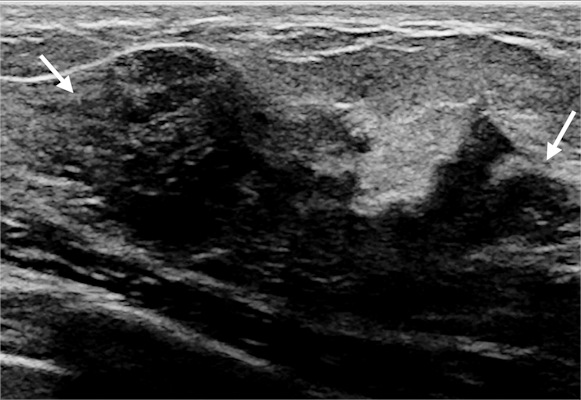
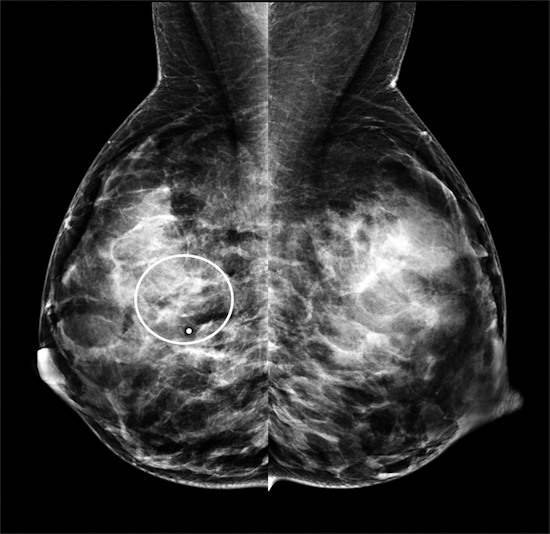
Imaging from a 40-year-old breastfeeding woman with a palpable lump in the right breast who was diagnosed with invasive ductal carcinoma
Imaging from a 40-year-old breastfeeding woman with a palpable lump in the right breast who was diagnosed with invasive ductal carcinoma. This targeted gray-scale ultrasound image shows a 2.4-cm hypoechoic irregular solid mass with indistinct margins (arrows) at the site of the palpable abnormality. All images courtesy of the RSNA.
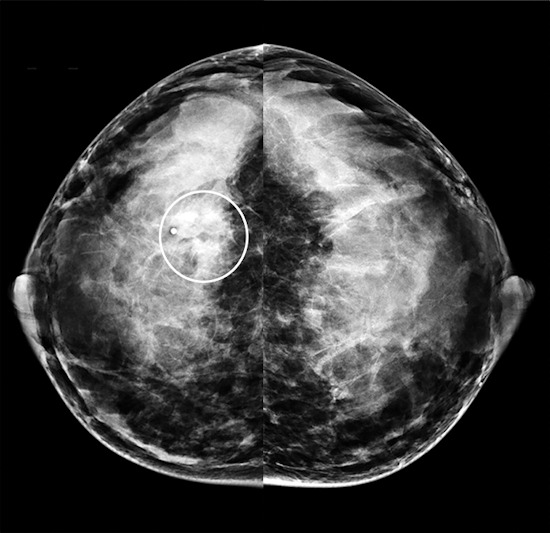
Craniocaudal mammogram from the same 40-year-old patient with invasive ductal carcinoma
Craniocaudal mammogram from the same 40-year-old patient with invasive ductal carcinoma. The patient's mammogram images show a subtle, obscured mass at the site of the palpable abnormality (region of interest) with some associated amorphous calcifications.
Mediolateral oblique mammogram from the same 40-year-old patient with invasive ductal carcinoma
Mediolateral oblique mammogram from the same 40-year-old patient with invasive ductal carcinoma. Both mammograms depict heterogeneously dense breast tissue.

The authors attributed mammography's lower specificity due to the modality's struggle depicting cancers in dense breast tissues during pregnancy and lactation. Notably, 98% of the patients in the study had dense breast tissue, including 72% of whom had extremely dense breast tissue.

The authors cautioned that selection bias could have even overstated the performance of mammography in their study. Still, they noted mammography may benefit lactating women ages 40 or older, which only comprised a small subset of their study population.

"Mammography may be of greater benefit in lactating women age 40 years or older in whom the incidence of breast cancer is higher," they wrote. "More data are needed to confirm the best imaging algorithm in this small subset of patients.