Tổng số lượt xem trang

Thứ Tư, 23 tháng 12, 2020

Ultrasound outperforms x-ray for neonatal pneumothorax

By Theresa Pablos, AuntMinnie staff writer

December 23, 2020 -- Lung ultrasound (LUS) scans outperformed chest x-rays for diagnosing neonatal pneumothorax in a new review that included more than 500 newborns. Ultrasound achieved better sensitivity and specificity and took less time to perform, according to the December 16 study in Ultrasound in Medicine & Biology.

Pneumothorax is a common but life-threatening illness seen in neonatal intensive care units. While CT is the gold standard for diagnosing pneumothorax in adults, chest x-ray is the preferred modality for newborns in order to reduce exposure to ionizing radiation.

Still, chest x-ray has its limitations for neonates. Newborns are especially at risk for latent effects from repeated exposure to ionizing radiation, and it can be difficult to detect pneumothorax with chest x-ray.

Instead, lung ultrasound may be the better first-line imaging modality for diagnosing pneumothorax in infants. Not only does ultrasound not expose infants to ionizing radiation -- it also appears to be more accurate.

"LUS is a new choice for the diagnosis and treatment of neonatal [pneumothorax]," wrote the authors, led by Qiang Fei, PhD, a professor at Zhejiang University School of Medicine in Hangzhou, China. "Compared with [chest x-ray], ultrasound combines the advantages of bedside diagnosis, avoidance of irradiation, cost-effectiveness, high accuracy, and reliability."

For the review, Fei and colleagues reviewed both Chinese- and English-language databases to find prospective studies investigating the diagnostic performance of chest x-ray and lung ultrasound for neonatal pneumothorax. Eight studies with a total of 529 infants met their inclusion criteria.

Lung ultrasound performed better than chest x-ray in the review. Ultrasound netted a sensitivity of 98% and specificity 99%, compared to 82% and 96% for chest radiography. Furthermore, ultrasound achieved an area under the curve of 0.997 and was faster to perform in five out of the eight studies.

The authors also calculated the diagnostic odds ratio (DOR) for both modalities -- a measurement of the effectiveness of a diagnostic test where higher numbers represent more effectiveness. Lung ultrasound achieved a DOR of 920, while chest radiographs had a DOR of 45.

Chest x-ray vs. lung ultrasound for neonatal pneumothorax
 Chest x-rayLung ultrasound
Sensitivity82%98%
Specificity96%99%
Diagnostic odds ratio (DOR)45920

"[Chest x-ray] is associated with a certain rate of misdiagnosis and is less sensitive than LUS for the diagnosis of mild-to-moderate [pneumothorax], especially in premature infants," Fei and colleagues wrote.

They theorized that chest x-ray may have limited usefulness in this population because the lesions are small and can be deep in the lungs. Meanwhile, ultrasound may be better suited to imaging the thin chest walls and narrow thorax of newborns.

The authors didn't have enough studies to sufficiently evaluate the accuracy of lung ultrasound features for diagnosing pneumothorax. However, the disappearance of lung sliding and B-lines and the presence of A-lines looked promising as diagnostic markers of the illness. In addition, the presence or absence of lung points -- where the visceral and parietal pleural surfaces meet -- looked useful for helping to determine illness severity.

Based on the findings, the researchers recommended lung ultrasound as a first-line modality for diagnosing pneumothorax in this population.

"[Chest x-ray] could be carried out as the second-line procedure if there are doubts about the findings during LUS examination, such as examination of neonates with large-area atelectasis," they wrote.


Thứ Hai, 7 tháng 12, 2020

Elastography shows promise for rotator cuff tears

By Theresa Pablos, AuntMinnie staff writer


December 4, 2020 -- Ultrasound with a shear-wave elastography (SWE) technique was comparable to MRI for preoperative evaluation of rotator cuff tears, according to a Thursday presentation at the RSNA 2020 virtual meeting. Elastography measurements showed moderate correlation with MR metrics in the 60-patient study.

Assessing muscle quality is critical for planning surgery to repair the supraspinatus muscle in patients with a torn rotator cuff. While MRI has been long used to evaluate rotator cuff muscles, SWE has emerged as a promising new metric that can be performed at the point of care in order to measure muscle elasticity.

"SWE may be useful to predict tendon repairability by evaluating muscle quality," said presenter Dr. Eun Kyung Khil from the radiology department at Hallym University Dongtan Sacred Heart Hospital in Hwaseong, South Korea.

The prospective study compared ultrasound SWE measurements and conventional MRI metrics for predicting whether surgery to repair the supraspinatus muscle would be successful. It included 60 patients with supraspinatus tears who underwent both preoperative MRI and ultrasound scans between May 2019 and August 2020.

One radiologist with five years of musculoskeletal imaging experience performed the ultrasound scans, which the researchers used to calculate the mean elasticity score, median elasticity score, and elasticity ratio.

Elasticity was calculated using a longitudinal ultrasound scan of three regions of interest of the supraspinatus muscle, and the scan was repeated three times in order to have nine total region-of-interest measurements. Meanwhile, the elasticity ratio was calculated by dividing the mean elasticity of the supraspinatus muscle by mean elasticity of the trapezius muscle.

In addition, two radiologists read MRI images, which were acquired with a 3-tesla system. The researchers used the following three standard tools to measure muscle evaluation:

  • Goutallier grade system to account for fat-to-muscle ratio
  • Occupation ratio of the area of supraspinatus muscle to the supraspinatus fossa
  • Warner's muscle atrophy grade

The authors compared the ultrasound and MRI measurements for patients whose surgery was successful, defined as a complete or near-complete repair of the rotator cuff, to patients with an incomplete rotator cuff repair.

MRI and SWE measurements in patients who underwent supraspinatus repair surgery
 Complete repairIncomplete repairp-value
MRIGoutallier grade1.83.78< 0.001
Occupation ratio59.8831.56< 0.001
Muscle atrophy grade0.392.33< 0.001
SWEEmean, kPa31.2543.84< 0.001
Emedian, kPa29.943.54< 0.001
Eratio(SST/Tra)1.843.68< 0.001

Patients with a successful rotator cuff repair surgery had significantly higher scores on both ultrasound and MRI. Both the mean and median elastography measurements were at least 10 kPa higher in the incomplete repair group.

In addition, Khil said the sensitivity and specificity of SWE were high when using a mean elasticity cutoff value of 35.06 kPa and an elasticity ratio cutoff value of 2.61.

Furthermore, the three elastography measurements on ultrasound showed decent correlation with the MRI metrics. The correlation was particularly strong for the elasticity ratio, which had a coefficient agreement of 0.57 with Goutallier grade and 0.66 with muscle atrophy grade on MRI.

"The correlation coefficient was over 0.4, showing a significant moderate correlation, especially in elasticity ratio," Khil said.

The findings were limited by a small number of participants, especially those in the failed repair group. However, it still demonstrated that SWE looks promising for preoperative evaluation of rotator cuff tears.

"In the preoperative evaluation of [supraspinatus] muscle quality using SWE, especially elasticity ratio, showed moderate correlation with existing MR measurements," Khil said.

Thứ Tư, 2 tháng 12, 2020

MRI, U S diagnose post-COVID-19 muscle weakness

By Kate Madden Yee, AuntMinnie.com staff writer


December 1, 2020 -- A combination of MR neurography and ultrasound could help clinicians better diagnose what is causing some recovered COVID-19 patients to continue to experience chronic pain, numbness, or weakness in their hands or limbs, according to commentary published December 1 in Radiology.

The article suggests that combining the two imaging modalities is an effective way to identify nerve damage that results from COVID-19, especially as patients recover and are tracked long-term, lead author Dr. Swati Deshmukh of Northwestern University in Chicago said in a statement released by the university.

"There are physicians out there who are seeing these otherwise young, healthy patients, and they don't know exactly what's wrong and they're thinking, 'What am I supposed to do for patients with post-COVID pain and weakness?' " Deshmukh said. "I want physicians and patients to be aware of the diagnostic options available due to recent innovations in technology and inquire if advanced imaging might be right for them."

As the COVID-19 pandemic has continued, clinicians have observed neuromuscular complications of the illness as those who have recovered participate in rehabilitative care. Imaging is a key tool for evaluating what causes these complications -- from inflammatory neuropathy, to prone positioning-related compression injuries, to nerve entrapment as the result of hematoma, Deshmukh's group noted.

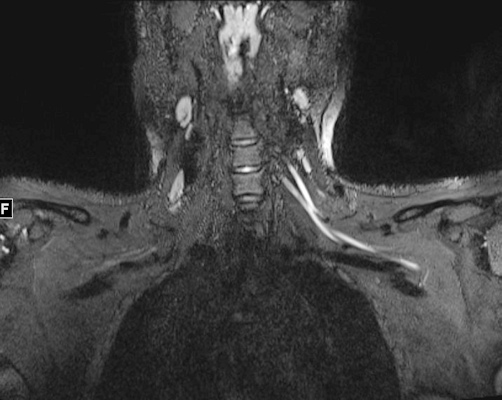
An MR image of a patient in their early 20s shows nerve injury of the left brachial plexus in the neck. The patient experienced left arm weakness and pain after recovering from COVID-19 respiratory illness, which prompted them to see their primary care physician
An MR image of a patient in their early 20s shows nerve injury of the left brachial plexus in the neck. The patient experienced left arm weakness and pain after recovering from COVID-19 respiratory illness, which prompted them to see their primary care physician. As a result of the MRI findings, the patient was referred to the COVID-19 neurology clinic for treatment. Image and caption courtesy of Northwestern University.

Determining the cause makes treatment more effective, according to the team. If the cause is due to injury from prone positioning, a patient would be referred for rehabilitation or peripheral nerve surgery. If nerve damage has been caused by inflammatory response, the patient should see a neurologist. And if the damage is caused by hematoma, blood thinner medications should be adjusted and surgery may be necessary, according to the group.

Ultrahigh-resolution ultrasound and MR neurography (which visualizes the peripheral nerves) can localize the problem and assess the severity of nerve damage and whether that damage has affected the muscles, according to the team.

"Peripheral nerve imaging aids diagnosis and may guide management in COVID-19 patients with neuromuscular symptoms arising from the infectious disease, hospitalization course, or secondary to a complication in treatment

Chủ Nhật, 29 tháng 11, 2020

US AI solves real-world clinical problems


AI helps solve real-world clinical problems

By Adam Davidson, AuntMinnie.com contributing writer


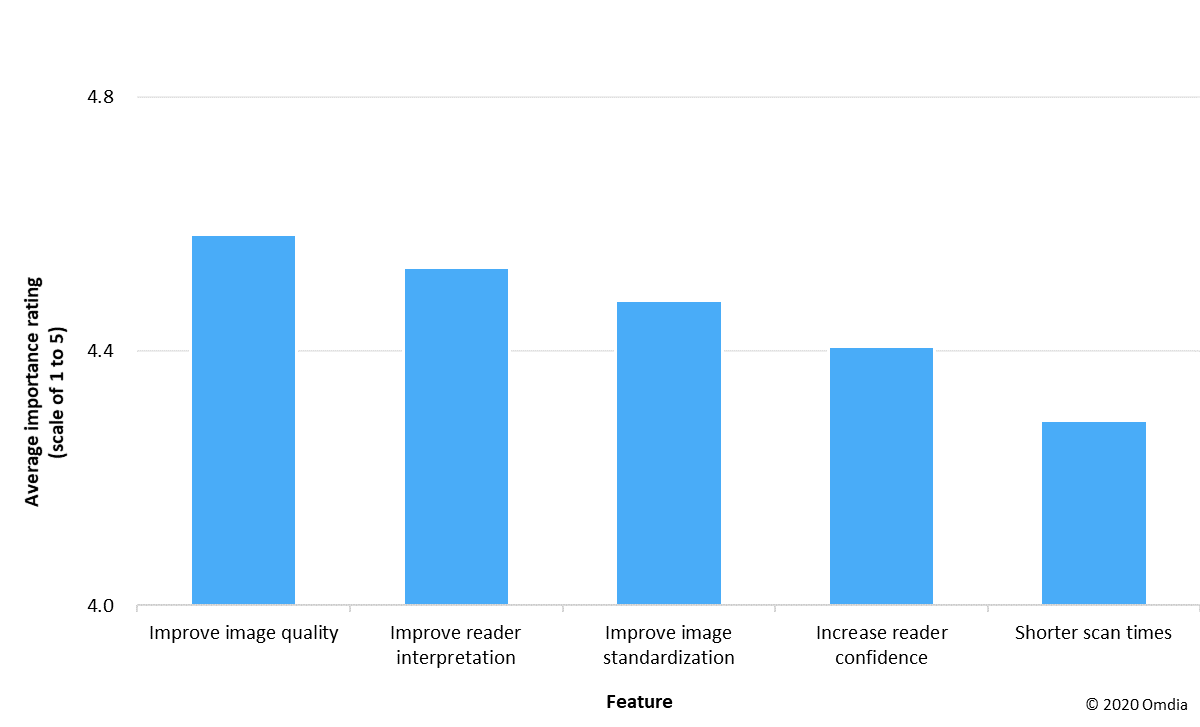
AI can walk ultrasound users through scans and enhance the image, ensuring the acquisition of high-quality and consistent scans that can be easily interpreted.

AI can also identify anatomy and anomalies on scans and make measurements to help readers interpret scans. AI can serve as a safeguard, ensuring that the radiologist does not miss any areas of concern on a scan, and as a second opinion, improving the radiologist's confidence in their diagnosis.

The chart below lists the importance of various AI tasks, as indicated in an Omdia survey of users.

Omdia radiology graph

According to the AIUS report, AI for ultrasound is versatile, with 60% of respondents' practices using AI in multiple clinical applications. AI utilization in general imaging was the most frequently reported clinical application, but Omdia expects AI utilization in point-of-care (POC), cardiology, and nontraditional applications to increase during the next few years as image libraries grow, enabling the development of more specialized algorithms.

The development of AI at the edge of care and in POC settings will drive integrated and cloud-based AI deployment in addition to the use of AI with portable medical imaging equipment.

..,

Thứ Bảy, 21 tháng 11, 2020

ED labels 84% of its abdominal ultrasound exams as inappropriate, causing downstream problems

ED labels 84% of its abdominal ultrasound exams as inappropriate, causing downstream problems


Abdominal pain is among the reasons patients visit the emergency department, with CT and ultrasound both serving as front-line tests to assess such complaints. New data suggests, however, that many of these exams are ordered inappropriately, leading to negative downstream consequences. 

That’s what researchers discovered after analyzing more than 250 exams completed at a non-trauma tertiary care hospital over a three-month span. Based on the American College of Radiology appropriateness criteria, 36% of CT scans were inappropriately ordered along with 84% of ultrasound exams. 

Guideline-discordant US images also caused providers to utilize an additional imaging modality in 20% of cases, causing longer ED stays, extra tests, and added costs, the authors wrote Sunday in Current Problems in Diagnostic Radiology

The reasons for these high numbers are multifaceted, but malpractice fears and concerns over missing a low-probability diagnosis likely top the list, Martina Zaguini Francisco, MD, with the Federal University of Health Sciences of Porto Alegre in Brazil, and colleagues explained. 

The team also pointed to educational gaps as a sizable problem.

“Although there is wide and ready dissemination of ACR tools, the lack of awareness of existing guidelines remains a major problem,” Zaguini et al. wrote. “This results not only in imaging overuse but also in wrong modalities being requested, leading to additional imaging orders during the same visit.”


More than 85% of emergency physicians admit to ordering too many tests, the researchers explained. And exams may be considered inappropriate for many reasons, including choosing the wrong modality, opting for one test over a more appropriate first-line exam, or if a test doesn’t change therapeutic management. 

With this in mind, Zaguini et al. retrospectively reviewed 135 CT and 143 US exams ordered for abdominal complaints in the ED between January and March 2019. 

They found that appropriately ordered exams were “significantly” more likely to yield findings compatible with clinicians’ initial diagnosis.

“This highlights the high impact that correct exam selection has on finding confirmative or actionable results on imaging,” the authors wrote.

Based on ACR Appropriateness Criteria, inappropriate CT scans were most often ordered for biliary disease, pancreatitis, renal failure, and uncomplicated pyelonephritis. 

For ultrasound, meanwhile, discordant exams were typically requested for acute abdominal pain, uncomplicated pyelonephritis, diverticulitis, and appendicitis. 

The study was limited by its single-center design and may not be generalizable to other organizations, the authors noted.