Tổng số lượt xem trang

Thứ Sáu, 29 tháng 1, 2021

Philips debuts ultrasound tools for AAA

By AuntMinnie.com staff writers


January 27, 2021 -- Philips Healthcare parent Royal Philips has introduced 3D ultrasound-based technology to monitor abdominal aortic aneurysms (AAAs)

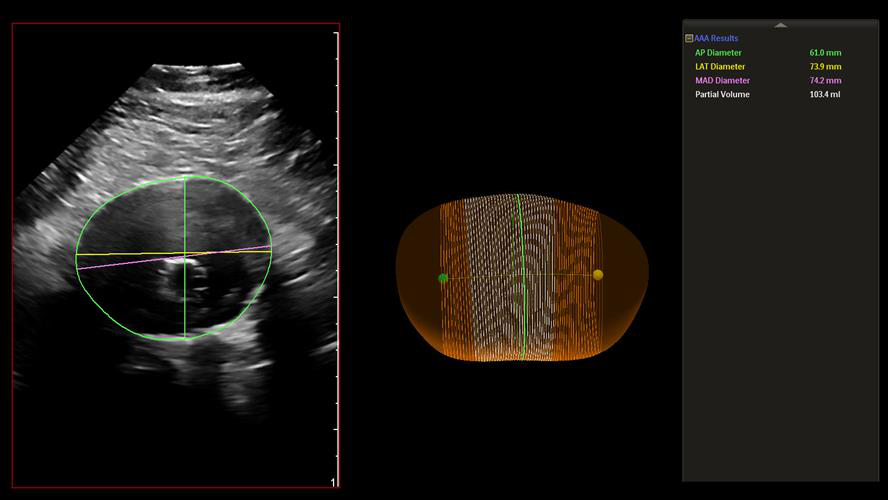
The company's AAA model is designed to assist clinicians by providing key measurements, including the partial volume and centerline of aneurysms.

The AAA model has received the CE Mark in Europe, and the U.S. Food and Drug Administration has cleared it for sale in the U.S. The model is making its debut at the virtual Leipzig Interventional Course (LINC), which is currently underway.

The AAA model provides measurements including the maximum anterior-to-posterior diameter and partial volume of the aneurysm, while also indicating the centerline
The AAA model provides measurements including the maximum anterior-to-posterior diameter and partial volume of the aneurysm, while also indicating the centerline. Image courtesy of Philips Healthcare


Chủ Nhật, 24 tháng 1, 2021

Seno gets FDA nod for breast optoacoustic ultrasound

By AuntMinnie.com staff writers

January 19, 2021 -- Optoacoustic imaging firm Seno Medical Instruments has garnered U.S. Food and Drug Administration (FDA) premarket approval (PMA) for its Imagio breast imaging optoacoustic ultrasound system.

Designed to help providers characterize and differentiate breast masses in real-time, Imagio combines laser optics and grayscale ultrasound to provide fused functional and anatomical breast imaging, according to the vendor. These optoacoustic images provide a blood map in and around breast masses, while the ultrasound technology yields a traditional anatomic image, Seno said. The company believes that Imagio could help to reduce the number of unnecessary diagnostic breast biopsies.

Imagio also comes with SenoGram, an artificial intelligence (AI)-based decision-support tool for aiding radiologists in interpreting the new images and helping them in transitioning from ultrasound alone to optoacoustic ultrasound imaging, the firm said.


Thứ Sáu, 22 tháng 1, 2021

Ultrasound shows lymph node changes after COVID-19 vaccine

By Theresa Pablos, AuntMinnie staff writer

January 22, 2021 -- Breast ultrasound was used to demonstrate signs of lymph node enlargement in four cases of patients who received the COVID-19 vaccine. Radiologists from NewYork-Presbyterian published the case studies on January 18 in Clinical Imaging.


The case studies involve women in their 40s and 50s who presented to the radiology department for breast imaging within two weeks of receiving a Pfizer-BioNTech or Moderna COVID-19 vaccine. Breast ultrasound showed the women had at least one enlarged lymph node. In all cases, the authors recommended follow-up imaging at a later time.

"With widespread rollout of the COVID-19 vaccine, it is prudent for radiologists to consider vaccine-induced hyperplastic adenopathy as an etiology of unilateral axillary adenopathy seen on breast imaging," wrote the authors, led by Dr. Nishi Mehta, a radiology fellow at NewYork-Presbyterian/Weill Cornell Medical Center.

Axillary adenopathy can be a sign of breast cancer. But it can also result from a number of benign causes, including local infection, inflammation, or trauma in the breast, thoracic wall, or nearby arm.

Vaccines are one reported benign cause of one-sided axillary adenopathy, and the symptom has been documented after vaccination for smallpox, bacillus Calmette-Guerin (tuberculosis), and anthrax. It appears more often in vaccines that evoke a very strong immune response.

As reported in the study, axillary adenopathy can occur after vaccination with the Pfizer-BioNTech and Moderna COVID-19 vaccines. The U.S. Centers for Disease Control and Prevention (CDC) lists axillary adenopathy as one of the most frequently reported adverse reactions to the Moderna COVID-19 vaccine. The CDC also noted more adenopathy cases occurred in patients who received the Pfizer-BioNTech vaccine than a placebo.
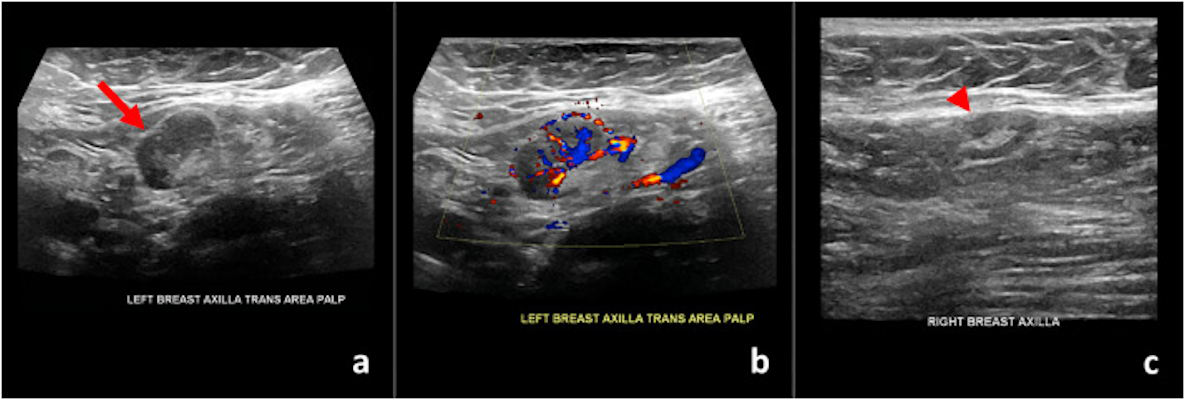
Ultrasound images of a 59-year-old patient who found a palpable lump nine days after receiving the first dose of the Pfizer-BioNTech vaccine in her left arm
Ultrasound images of a 59-year-old patient who found a palpable lump nine days after receiving the first dose of the Pfizer-BioNTech vaccine in her left arm. (a) Gray-scale and (b) color Doppler images of an enlarged left axillary lymph node. (c) Normal right axillary lymph node. All images courtesy of Dr. Nishi Mehta / Clinical Imaging.

This appeared to be the case for four women who presented for breast imaging at NewYork-Presbyterian. The patients had no preexisting conditions and were all frontline workers who qualified for the first round of Moderna or Pfizer-BioNTech vaccines.

In one case, a 59-year-old woman with no personal history of breast cancer came to the department after finding a palpable lump near her left armpit. Her mammogram was unremarkable, but targeted sonography showed her left axillary lymph node had uniform cortical thickening of 0.7 cm in an area corresponding to the patient's concern.

When asked about her history, the patient said she had recently received the Pfizer-BioNTech COVID-19 vaccine and noticed the lump nine days after receiving her first vaccine dose.
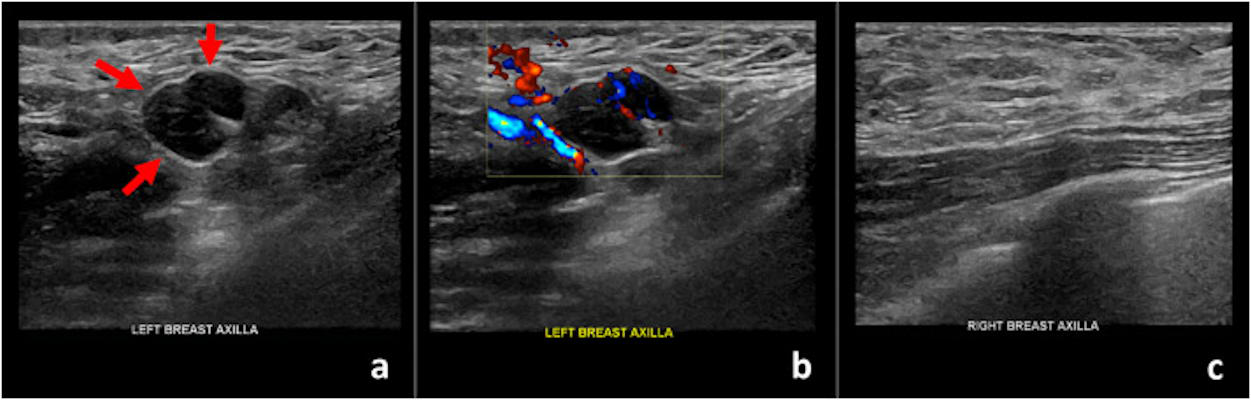
Ultrasound images of a 42-year-old patient who presented for sonographic follow-up of probably benign bilateral breast masses
Ultrasound images of a 42-year-old patient who presented for sonographic follow-up of probably benign bilateral breast masses. The patient had received the first dose of the Moderna vaccine in her left arm 13 days prior to imaging. (a) Gray-scale and (b) color Doppler images of an enlarged left axillary lymph node. (c) Unremarkable right axilla.

The authors reported similar findings in two women who presented for routine breast ultrasound screening, as well as one woman who underwent ultrasound follow-up of probably benign bilateral breast masses. All three of these women had diffuse cortical thickening in at least one axillary lymph node within 13 days of receiving a first or second vaccine dose.

In all four cases, the authors recommended follow-up imaging with targeted ultrasound. NewYork-Presbyterian is currently recommending clinicians delay follow-up ultrasound imaging until four to 12 weeks after patients receive their second COVID-19 vaccine dose. If the adenopathy still persists at this time, then the authors would recommend biopsy to rule out cancer.

While the report focused on breast imaging, Mehta said breast imagers aren't the only types of radiologists who may come across axillary adenopathy.

"Thoracic imagers will likely see similar findings of unilateral axillary adenopathy and cervical adenopathy on chest imaging studies and should therefore be similarly aware of the diagnosis," she told AuntMinnie.com.

Axillary adenopathy may also be seen on mammography, noted Mehta. Axillary adenopathy after vaccination has also been documented as increased FDG uptake on PET and CT, she added.

"We expect similar findings post COVID-19 vaccination," she said.
Thứ Hai, 18 tháng 1, 2021

POCUS group launches MSK certification

 By AuntMinnie.com staff writers


January 18, 2021 -- The Point-of-Care Ultrasound (POCUS) Certification Academy has launched a new certification program for healthcare providers that use ultrasound in the provision of physical therapy and other disciplines

The academy's POCUS Musculoskeletal (MSK) Certification supports a new measure of proficiency with POCUS that raises the standard of musculoskeletal imaging by testing on best practices of clinical applications.

The certification is designed to support professionals in the fields of physical therapy, physiatry, athletic training, sports medicine, and orthopedics, among others.

Thứ Năm, 14 tháng 1, 2021

Thyroid cancer screening hits the right note


By Theresa Pablos, AuntMinnie staff writer

January 14, 2021

The ultrasound technique works because singing causes the elasticity of surrounding tissues to increase, making it easier for clinicians to pinpoint abnormally stiff areas. Singing during thyroid ultrasonography also has the potential to identify more thyroid tumors while simultaneously putting patients at ease.

"Developing noninvasive methods would reduce the stress of patients during their medical exams," stated lead author Steve Beuve, a doctoral student specializing in medical imaging at University of Tours, in a press release. "Having to sing during a medical exam can perhaps help release some of the nervous tension even more."

The authors called their new technique vocal passive elastography. The method was inspired by passive elastography, which detects changes in elasticity from natural vibrations caused by blood pulsing, heart rhythms, and other natural biological changes.

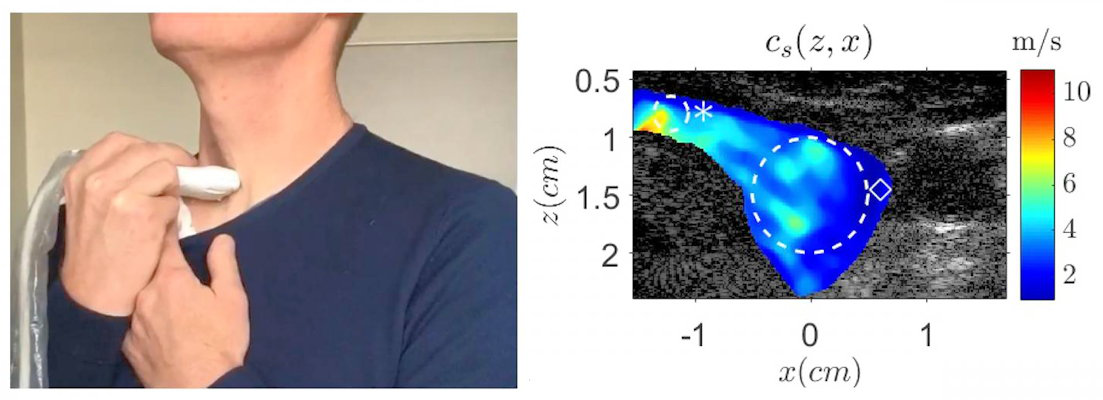
During vocal passive elastography, a clinician places a linear ultrasound probe at the front of a patient's neck. The patient then sings and maintains the "eee" tone, trying to match their tone to a 150-Hz sound playing from a speaker.

The singing vibrates the patient's trachea, which in turn produces vibrations throughout the thyroid. This allows the clinician to use an ultrafast frame rate to track changes in shear-wave velocity.

"The propagation of shear waves gives us information about mechanical properties of soft tissues," Beuve stated.

For their experiment, the team validated the concept by calculating shear-wave elastography (SWE) measurements as patients sang, then superimposing a map of that data onto B-mode ultrasound images. They created their own algorithm to reconstruct the raw image data and tested their algorithm on two different ultrasound systems.

The vocal passive elastography method succeeded in identifying particle tissue displacement induced by singing on both systems. The values also aligned well with SWE metrics, although the measurements were more similar on the left (thinner) side of the thyroid than on the right (thicker) side.

A volunteer holds a linear ultrasound probe to help prove the feasibility of vocal passive elastography
Left: A volunteer holds a linear ultrasound probe to help prove the feasibility of vocal passive elastography. Right: 2D shear wave speed as calculated by the new technique mapped onto an anatomical brightness mode ultrasound image. Image courtesy of Steve Beuve.

Overall, vocal passive elastography looked like a promising alternative to fine-needle aspiration biopsy, which misses up to 95% of thyroid cancers, according to the authors. It also drastically improved the thyroid signal-to-noise ratio by drowning out natural background noise from nearby organs.

The researchers are already conducting new experiments to further refine the technique, including investigating the benefits of asking patients to match different bandwidths. They are also interested in expanding the use of vocal passive elastography to areas outside of the vocal tract, such as the brain.

"We want to cooperate with physicians to propose protocols to verify the relevance of elasticity as a biomarker of pathogens," Beuve stated