Tổng số lượt xem trang

Thứ Tư, 1 tháng 7, 2020

3D ultrasound is effective for measuring blood flow


AuntMinnie.com  

July 1, 2020 -- Researchers from across the U.S. confirmed the efficacy of 3D color-flow ultrasound for cheaply and reliably measuring blood flow. The findings, which were published on June 30 in Radiology, could help physicians precisely measure blood flow for people with chronic conditions.
The new approach resulted in as little as a 3%-5% difference in measurements between laboratories and operators. Based on the findings, lead study author Oliver Kripfgans, PhD, said the question of the technology's clinical adoption isn't an "if" but a "when."
"These are fantastic results that show that, from a technology point of view, some systems could be ready to go to the clinic," stated Kripfgans, an associate professor of radiology at Michigan Medicine in Ann Arbor, MI, in a press release.
2D ultrasound technology is rarely used to gather precise, quantitative blood flow measurements because results can greatly vary between facilities and operators. In addition, other noninvasive techniques to measure blood flow, such as blood pressure monitoring, can only provide qualitative data.
Kripfgans and his colleagues at Michigan Medicine had previously developed a 3D color-flow ultrasound approach to overcome the limitations of alternative measurement solutions. The researchers tested the method in the new, prospective study, which received funding from the U.S. National Institutes of Health, RSNA, and the American Institute of Ultrasound in Medicine.
For the study, Canon Medical Systems, Philips Healthcare, and GE Healthcare donated 3D ultrasound systems. The vendors modified the systems with data access software and provided the researchers with color-flow velocity, color-flow power, and scan geometry.
Trained medical or engineering staff at three different locations performed the same experimental steps using the three systems:
1.They measured volume flow from 1 - 12 mL/sec in steps of 1 mL/sec at a depth of 4 cm.
2.They measured depth-dependence from 2.5 - 7.5 cm in steps of 0.5 cm.
3.They stepped color flow gain from no color to full blooming.
4.They measured flow volume distal to a lumen stenosis. They also measured three flows at each poststenosis position.

Example screenshot for poststenotic flow. Image courtesy of the RSNA.
The experiments were first performed with a steady, constant flow, then repeated again with a flow simulating a pulse of 60 beats per minute. In the end, the researchers had 730 datasets with 18,450 images.


The use of 3D color-flow ultrasound produced measurements that were accurate and reproducible. Two out of the three ultrasound systems tracked within 10% for measuring flow response, the authors noted.
The approach is promising because it requires no hardware changes and can lead to practical clinical uses for measuring peripheral vascular flow and cerebral blood flow. While it will need to be further evaluated and may not work for all types of blood flow measurements, Kripfgans is optimistic about its clinical potential.
"Once the technique becomes available commercially on scanners, clinical adoption will be much faster because then it's not a research project anymore -- it's something that's readily available, and after that, it's just a matter of time before it reaches the clinic," Kripfgans stated.

Thứ Bảy, 13 tháng 6, 2020

Ultrasound for Primary Breast Screening

By Theresa Pablos, AuntMinnie staff writer


June 11, 2020 -- Could ultrasound be used as a primary screening method for breast cancer? A long-term systematic review published on June 1 in BMC Cancer found ultrasound scans performed well as both a primary and secondary cancer screening modality.
The review, conducted by researchers in China, pooled data from almost two dozen studies evaluating the effectiveness of ultrasound for breast cancer screening. Ultrasound screening performed comparably to mammography in most categories and may work particularly well as a screening method for women with dense breasts, the authors noted.
"Up to now, there have been no consistent conclusions concerning whether [ultrasound] screening should be recommended as the primary screening method for women in the screening guidelines for breast cancer," wrote lead authors Lei Yang and Shengfeng Wang from Peking University in Beijing.
Cancer detection, recall, and biopsy rates
The review included 23 English-language studies published between January 2003 and May 2018. Twelve of the studies evaluated the use of ultrasound as a secondary screening method after a negative mammography result, while the remaining 11 studies compared the effectiveness of ultrasound and mammography as primary screening modalities.
Mammography vs. ultrasound for breast cancer screening
 Mammography, primary screeningUltrasound, primary screeningUltrasound, secondary screening
Cancer detection rate per 1,000 examinations4.64.63.0
Recall rate4.6%5.9%8.8%
Biopsy rate1.5%2.3%3.9%
Percentage of all cancers detected65%68%N/A
Percentage of invasive cancers detected65%87%74%
The review found no statistically significant differences in sensitivity and specificity between ultrasound and mammography as primary breast cancer screening methods. Mammography detected 65% of cancers, comparable to the 68% of cancers detected through ultrasound scans. Similarly, mammography identified 97% of women without cancer, while ultrasound detected 98% of women without cancer.
Furthermore, both mammography and ultrasound identified 4.6 cancers per 1,000 examinations. Ultrasound scans detected significantly more invasive cancers than mammography, but the modality also resulted in a higher percentage of recalled patents. The researchers found no statistically significant differences between mammography and ultrasound for the percentage of biopsies or for detection of node-negative invasive cancers
When used as a secondary screening method after a negative mammogram result, ultrasound identified 96% of occult breast cancers and 93% of healthy patients. The modality also identified 3 cancers per 1,000 scans, with an 8.8% recall rate and a 3.9% biopsy rate. As a secondary screening method, ultrasound found 74% of invasive cancers and 71% of node-negative invasive cancers.
"Our study is the first systematic review and meta-analysis to investigate the performance of [primary ultrasound] screening for breast cancer, and that is also an important up-to-date systematic review and meta-analysis investigating the performance of [secondary ultrasound] screening," the authors wrote.
Benefits and limitations of ultrasound screening
Ultrasound has some benefits as a breast screening method, including that it is radiation-free and may be more accessible in low-resource countries and areas. However, it is also not without its limitations. For instance, ultrasound cannot image the whole breast at once or show microcalcifications, and it requires a skilled operator.
"However, as shown in our study, these concerns seemed not to cause significant differences in the sensitivity and specificity, or even in cancer detection rates and cancer characteristics between [primary ultrasound] screening and [primary mammography] screening," the authors wrote.
All of the studies in the review were graded as high or fair quality by the authors, but the review itself had some noteworthy limitations. Importantly, some of the ultrasound studies in the review included repeated screenings using the same group of individuals. For the analysis, the authors counted each screening as an individual person, which could have overestimated the benefit of ultrasound screening.
Despite its limitations, the authors noted the findings highlight the need for future studies to investigate the long-term benefits and risks of using ultrasound as a primary breast cancer screening method, particularly for use in women with dense breasts and those who live in rural or resource-poor areas.

"We hope that [ultrasound] screening for breast cancer should deserve more attention in the future, not only because [ultrasound] is comparable to [mammography] in women with dense breasts ... but also because ultrasound is not a radiation modality and is easier to access in low-resource areas, such as Chinese rural areas," the authors concluded.

LIVER 2D-SWE ARTIFACTS

 Two-dimensional shear wave elastography artifacts, although seen very frequently in a clinical setting, are poorly recognized. Our review emphasizes that interpretation of 2D-SWE images must incorporate knowledge of US artifacts.


Thứ Năm, 11 tháng 6, 2020

ULTRASOUND and SARCOPENIA


ABSTRACT

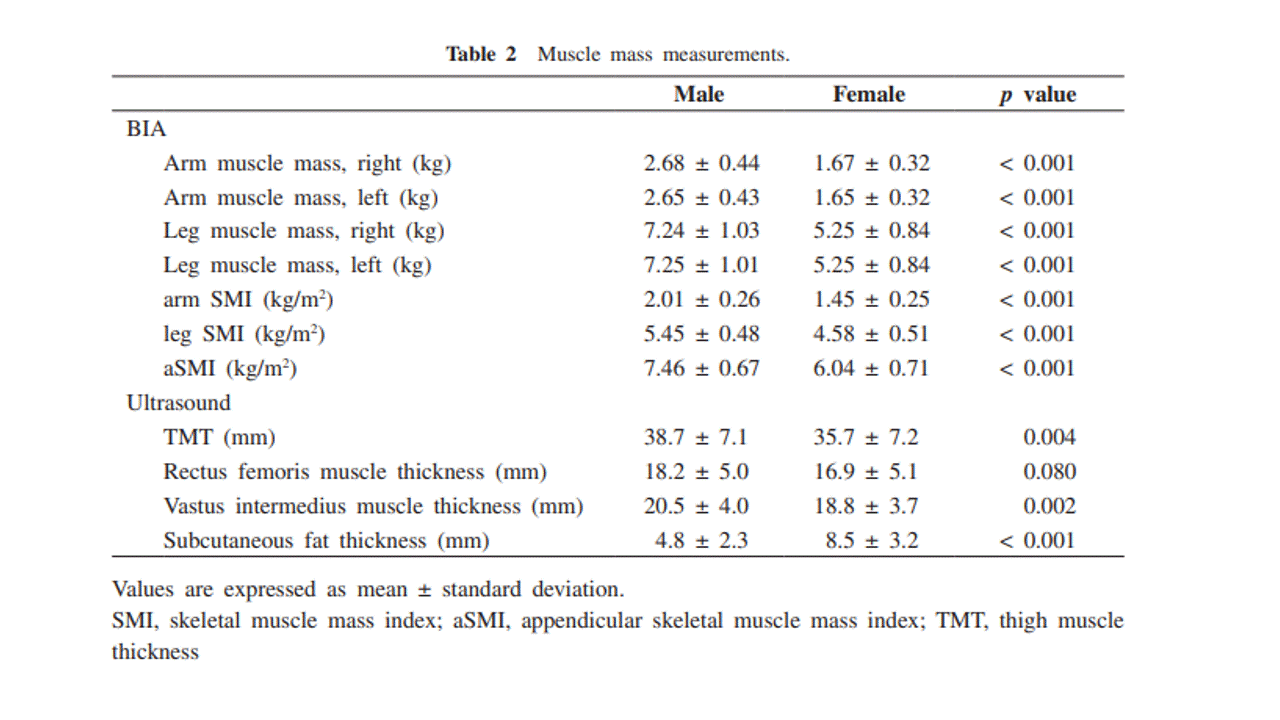
Our aim of this study is to compare the thigh muscle thickness measurements obtained using ultrasound and bioelectrical impedance analysis (BIA) methods, and to investigate the validity and cutoff value of the ultrasonography.
We analyzed a total of 201 participants (99 male and 102 female participants, mean age, 66.2 years) participated in the annual health checkup in the Yakumo Study, 2014. Thigh muscle thickness (TMT, sum of the rectus femoris and vastus intermedius muscle thickness) was measured using ultrasound at mid-thigh in the sitting position. Appendicular skeletal muscle mass (aSMI) was measured using BIA. Cutoff value of TMT was determined through the receiver operating characteristic analysis. We defined sarcopenia with the diagnostic algorithm of Asian Working Group for Sarcopenia.
TMT was significantly reduced in subject with sarcopenia than in those without sarcopenia in both gender. Muscle measurements obtained using the BIA methods (aSMI) and ultrasound methods (TMT) showed a significant correlation, with a correlation coefficient of 0.38 (P < 0.001). Cutoff value, sensitivity, and specificity of TMT in diagnosis of muscle loss were 36 mm, 72.0%, and 73.9%, respectively, for the male participants, and 34 mm, 72.2%, and 72.4%, respectively, for the female participants.
In conclusion, the ultrasonography for thigh muscle might be a simple diagnostic method for sarcopenia.

Keywords: ultrasonography, thigh muscle thickness, sarcopenia, community-dwelling people, cut-off value