Tổng số lượt xem trang

Thứ Hai, 6 tháng 9, 2021

Role of Lung Ultrasound in Patients with Severe COVID-19 in Low and Middle-Income Countries [LMICs]


In LMICs, what is the role of lung ultrasound in patients with severe COVID-19? Rationale.


Chest imaging can be essential in the diagnosis and management of patients with COVID-19. Published reports to date have focused mainly on standard chest x-ray (CXR) and chest computed tomography (CT). Abnormalities are very often present on CXR images of COVID-19 patients44; consolidations and ground-glass opacities have been reported in 47% and 33%, respectively. Not all patients with COVID-19 have abnormalities on chest CT images.45 Patchy ground-glass opacities, typically in a bilateral and peripheral locations, and consolidations have been most commonly described.46–48 In light of the high sensitivity of an abnormal scan, CT has even been suggested as a primary diagnostic tool for COVID-19.49,50 Challenges with access to CT and, at times, even simple CXR may preclude the usefulness of these imaging techniques in LMICs.

Lung ultrasound (LUS) is increasingly recognized as a chest imaging tool with a strong potential to guide management of critically ill patients and may represent a useful tool in patients with COVID-19. Search results. MEDLINE, Embase, and Web of Science were searched until May 2020. The search used combinations of MeSH terms and free-text words, including “COVID–19,” “coronavirus,” “SARS–CoV–2,” “‘radiography,” “chest radiography,” “CT,” “chest CT,” “CT,” “chest CT,” “ultrasound,” “LUS,” and “lung ultrasonography.” Several studies were found but none reporting data from LMICs.

 Evidence. For the diagnosis of pneumonia from causes other than COVID-19, LUS has been found to be superior to standard CXR, and it approaches chest CT in terms of diagnostic accuracy.51–53 Lung ultrasound had a better diagnostic yield than CXR in the early diagnosis of H1N1 2009 viral pneumonia.54 Experience with LUS in patients with COVID-19 is rapidly growing, with the consistent finding that nearly all COVID-19 patients have an abnormal LUS.55 

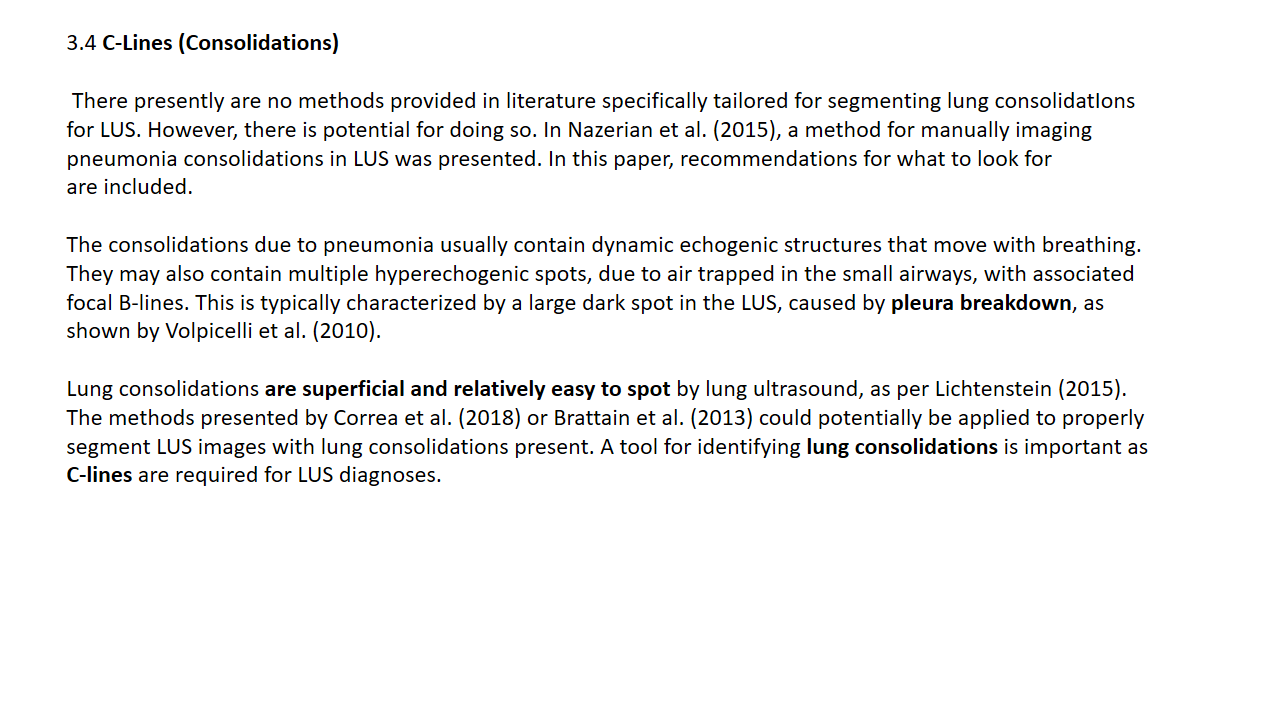
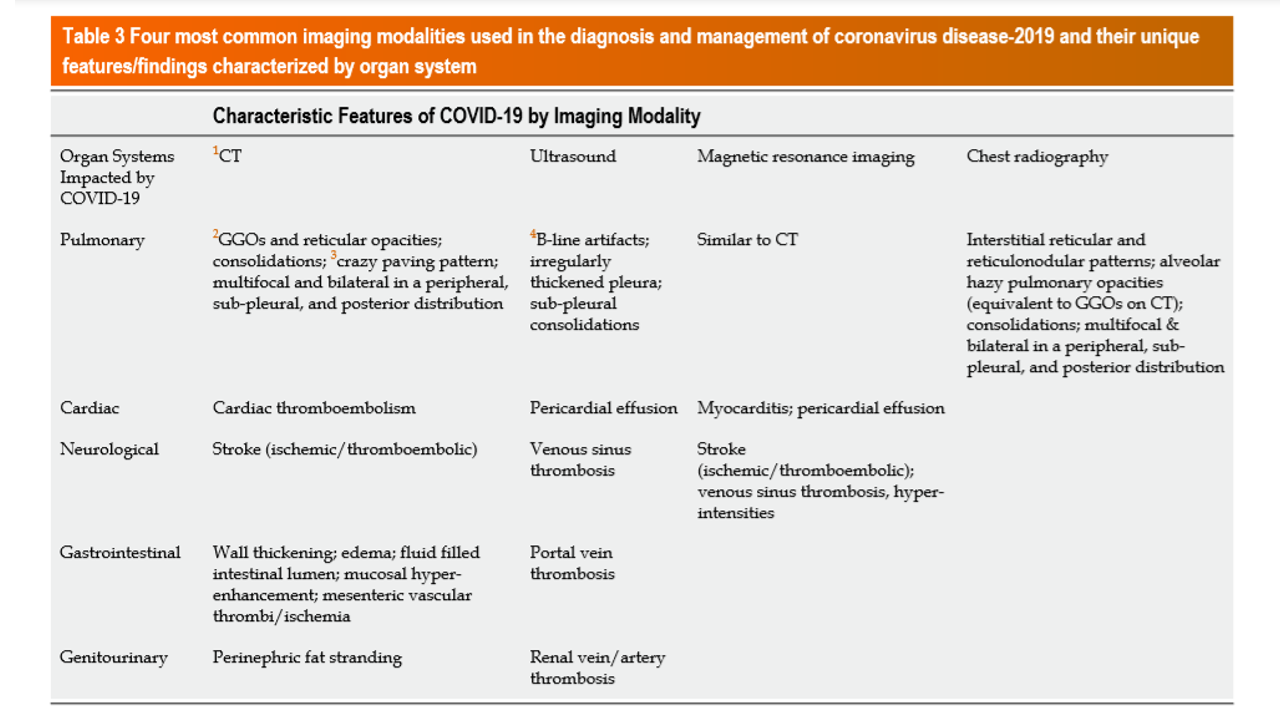
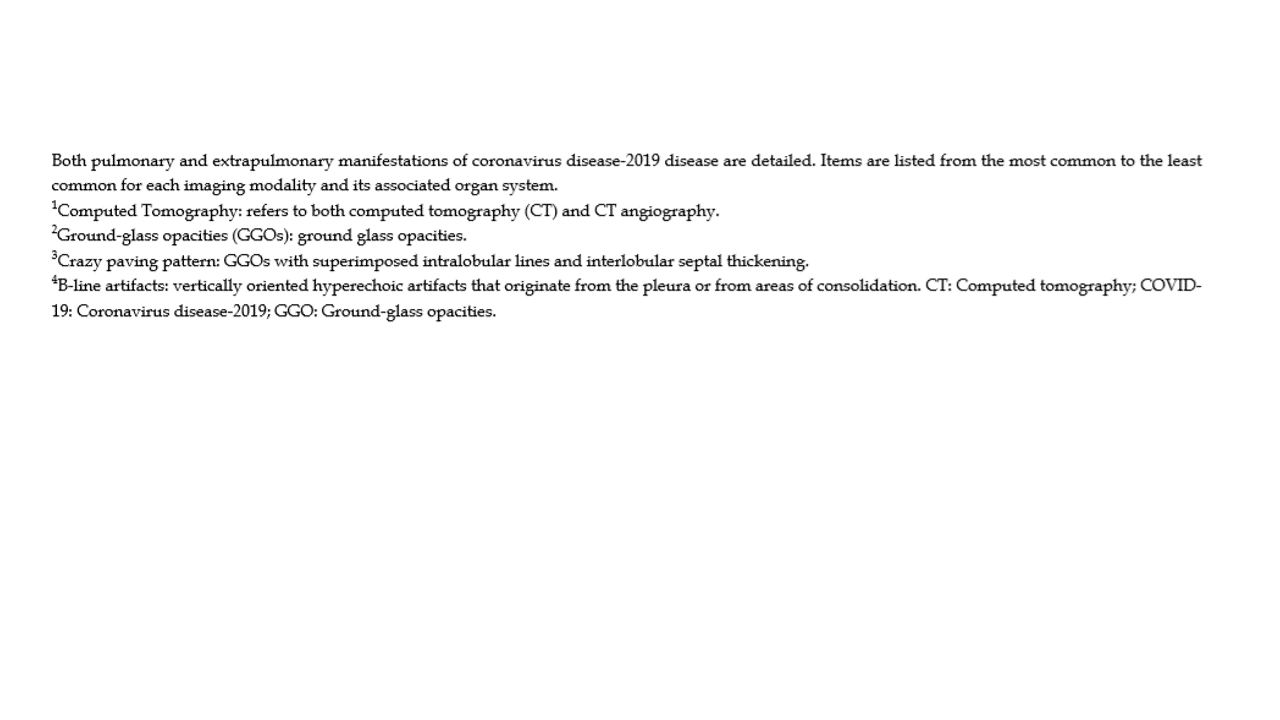
Four major findings are frequently described in COVID-19 patients (Figure 1), although the sensitivity and specificity of the following findings remain uncertain.56

 1. focal, multifocal, or confluent B-lines (in 97% of cases);

 2. pleural thickening (in 50% of cases);

 3. subpleural and pleural consolidations (in 40% of cases); and

 4. rarely, pleural effusions (in 16% of cases).57–61 A patchy distribution of multiform clusters alternating with “spared areas” (regions of normal lung parenchyma) is often observed.62 

One LUS finding of particular usefulness in COVID-19 is the “light beam,” a broad, lucent, band-shaped, vertical artifact that moves rapidly with sliding (see https:// link.springer.com/article/10.1007/s00134-020-06048-9), which may correspond to early ground-glass alterations on a chest CT scan. The precise diagnostic accuracy of this sign is currently being tested in a prospective study.63 Early reports suggest that the extent of LUS findings correlate with severity of lung injury in COVID-19.45 In one review of LUS in patients with COVID-19, the relative number and distribution of B-lines and consolidations approximated other parameters of clinical severity, including oxygen saturation, need for supplemental oxygenation, and respiratory rate.64 The WHO clinical management guidelines suggest that LUS be used to assist in COVID-19 diagnosis and identify or exclude pulmonary complications.1 Potentially useful scoring systems for patients with COVID19 are summarized in Table 2. A scoring system to quantify the degree of lung injury in patients with COVID-19 has been proposed for both ventilated and non-ventilated patients (Figure 1).65 In invasively ventilated patients, early quantification of the severity of lung involvement by LUS in patients with COVID-19 can be estimated by using the “LUS score,” 66 which has been extensively tested in ARDS patients.67,68 The dynamic changes in aeration can then potentially be quantified by reassessing the LUS score (Figure 2). A previous study in Rwanda proposed the use of LUS combined with pulse oximetry to diagnose ARDS (from causes other than COVID19) in a cohort of primarily non-ventilated patients.69 This approach was externally validated in invasively ventilated patients in the Netherlands,70 but its performance in COVID19 ARDS remains to be established. To our knowledge, there are currently no published studies comparing LUS with RT-PCR for the diagnosis of COVID-19. However, multiple studies looking at diagnosis (NCT0435180, NCT04370275, NCT04393402, NCT04338568, NCT04322487, and NCT04377035) or prognosis (NCT04379544, NCT04384055, and NCT04370249) are currently underway as of November 5, 2020. One of these studies is being performed in Turkey (NCT04399681). Availability, feasibility, affordability, and safety. Data on the availability of ultrasound devices in LMICs remain limited. In a recent multicenter observational study in 54 Asian ICUs, 54% of centers reported having a dedicated chest radiography apparatus versus 79% an ultrasound apparatus,71 and a hospital CT was available in 96% of centers. A bedside ultrasound machine was reported to be available sometimes in Haiti.72 Lung ultrasound studies in LMICs are still performed less frequently than abdominal and cardiac ultrasound.73 However, with the availability of smaller and cheaper devices and a growing body of evidence, wider use of LUS can be foreseen.74,75 Although cost-effectiveness studies in LMICs are lacking, LUS has been shown to reduce the use of CXR and chest CT in resource-rich ICUs, with less radiation exposure and lower costs.76,77 An important advantage of LUS is that it can be performed with most available ultrasound machines and probes. It remains an operator-dependent technique but can be taught readily to non-experts with little formal ultrasonography training. In an international, multicenter study across 10 ICUs, performance of 25 supervised LUS examinations resulted in sufficient acquisition of skills by non-experts for the assessment of the “LUS score.” 78 In more resource-restricted settings, a study of 20 participants in Ghana demonstrated good retention of cardiorespiratory ultrasonography principles 9– 11 months after participants received a training program.79 Point-of-care ultrasound training intervention in a resource restricted setting in Rwanda resulted in high numbers of diagnostic quality studies over long-term follow-up,80,81 although remote quality assurance feedback was found an effective educational tool in Uganda.

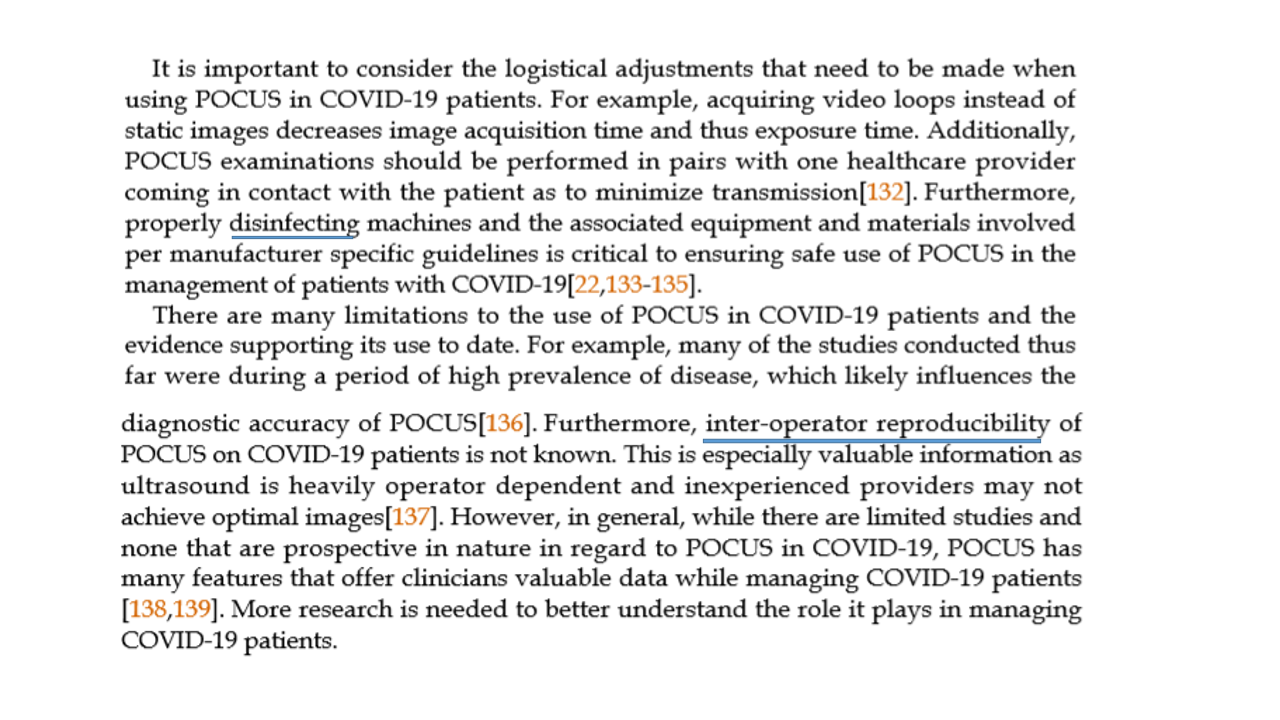
An important limitation of LUS is that it cannot detect lesions that are intrapulmonary and do not reach the pleural line.82 Usefulness of LUS via telemedicine is proposed, but direct evidence is still lacking.83 

Recommendations and suggestions (Table 1).

 1. In LMICs, where availability of standard CXR and CT is limited, we suggest using LUS to detect abnormalities to identify patients with possible COVID-19 (weak recommendation, low quality of evidence);

 2. In LMICs, we recommend against the use of LUS to exclude COVID-19 (UG best practice statement); 

3. In LMICs, we suggest using LUS in combination with clinical parameters to monitor progress of the disease and responses to therapy in COVID-19 patients (weak recommendation, low quality of evidence).

LMICs= Low and Middle-Income Countries


-----------


LINK DOWNLOAD


Thứ Sáu, 3 tháng 9, 2021

US scoring index shows promise in COVID diagnosis

By Amerigo Allegretto, AuntMinnie.com staff writer


September 3, 2021 -- A novel ultrasound scoring system that can be performed in less than 10 minutes is accurate for COVID-19 diagnosis and prognosis, according to research published August 31 in Ultrasound in Medicine and Biology.


A team led by Dr. Michele Spampinato from the University of Ferrara in Italy said that their lung ultrasound severity index could distinguish between patients who have COVID-19 and those who don't. It also can better identify patients who will experience in-hospital mortality when compared with standard lung ultrasound severity scores.

"In such an epidemiological scenario, in which a huge number of patients are admitted for the same disease, early differentiation of patients with highly infectious disease from patients with other causes of respiratory distress is essential," Spampinato and colleagues wrote.

Chest imaging has been a primary method of diagnosing and evaluating the severity of COVID-19, with ultrasound being touted as easily accessible and not exposing patients to radiation. However, studies are generally based on score systems that do not consider the patchy ultrasound appearance of SARS-CoV-2 pneumonia. The researchers said this is due to the different patterns displayed in the same area.

"In our opinion, this issue could be relevant to better assess lung ultrasound diagnostic characteristics in SARS-CoV-2 pneumonia," they added.

Spampinato et al created their lung ultrasound severity index to better describe the coexistence of different lung lesions in the same lung area. This in turn can be used to measure the quality and extent of lung involvement in relation to COVID-19 diagnosis, as well as in-hospital mortality of patients with respiratory distress admitted for suspected COVID-19.

They tested the accuracy of the index in a study with 159 patients (105 male, 54 female) with an average age of 64.6 years with suspected SARS-CoV-2 pneumonia. Out of these, 63.5% were diagnosed with COVID-19.

COVID-19 patients had a higher mortality rate (18.8% vs. 6.9%) and lung ultrasound severity index score (16.14 vs. 10.08) compared with non-COVID-19 cases.

The team compared the index to several other measures, including lung ultrasound severity score, the simple sum of lung ultrasound findings, and a lung ultrasound heterogeneity score, the number of different ultrasound patterns found in each area.

Prognostic characteristics of lung ultrasound scores for in-hospital mortality
 Lung ultrasound heterogeneity scoreLung ultrasound severity scoreLung ultrasound scoring index
Area under the receiver operating characteristic (AUROC)0.5760.7330.805
Sensitivity69.57%65.22%90.91%
Specificity48.53%73.53%65.67%
Odds Ratio1.0371.0451.14

The researchers said the scoring index combines the strengths of the other two scoring methods, citing the index's higher AUROC scores. The index's AUROC score for diagnosing COVID-19 was 0.72 and 0.76 for predicting in-hospital mortality for COVID-19 patients. Both were higher than the severity and heterogeneity scores.

The team also touted the amount of time it takes to perform an ultrasound scan, which averaged 8.05 minutes, much less than the several hours it takes to get information from lab exams, swabs, and high-resolution CT. The team said by using lung ultrasound and applying the scoring index to identify high COVID-19 risk, doctors can make better decisions about further imaging, urgent therapies, and a patient's destination.

Spampinato and colleagues called for more validation studies for lung ultrasound scoring with large patient populations, different clinical settings, and comparison with other imaging methods.

"Researchers should make every effort to reach an agreement on a standard of reference in the conducting, reporting, and grading pulmonary involvement in SARS-CoV-2 pneumonia," the study authors wrote.

Thứ Bảy, 21 tháng 8, 2021

GUT-LUNG AXIS in COVID-19 DISEASE


LUS in OLDER PATIENTS with POSSIBLE COVID-19 DISEASE


LUS helps to reviewing hemocoagulability status.  D-Dimer with high value and lung CT  later detects thrombosis of branches of pulmonary arteries in both lower lungs to plan for a anticoagulation therapy.


USING US STIMULATION to REDUCE INFLAMMATION in COVID-19 IN-PATIENTS


Thứ Hai, 16 tháng 8, 2021

IVERMECTIN for PREVENTION and TREATMENT of COVID-19 INFECTION


Thông tin cơ bản: Đổi mục đích trị liệu của thuốc để chống lại vi rút SARS-CoV-2. Ivermectin vốn dùng diệt ký sinh trùng, với các đặc tính kháng vi-rút và chống viêm, hiện đã được thử nghiệm phòng chống vi rút SARS-CoV-2 trong nhiều thử nghiệm lâm sàng.

Các lĩnh vực không chắc chắn: Chúng tôi đã đánh giá hiệu quả điều trị của ivermectin trong việc giảm tỷ lệ tử vong, các tác dụng phụ trong trị liệu, ở những người có nguy cơ hoặc nguy cơ cao nhiễm COVID-19.

Nguồn dữ liệu: Tìm dữ liệu để đánh giá cho đến ngày 25 tháng 4 năm 2021. Hai tác giả đã sàng lọc các nghiên cứu, trích xuất dữ liệu và đánh giá nguy cơ sai lệch. Các phân tích tổng hợp và tính chắc chắn của bằng chứng được đánh giá bằng cách sử dụng phương pháp GRADE và bổ sung trong các phân tích tuần tự thử nghiệm về tỷ lệ tử vong. Hai mươi bốn thử nghiệm ngẫu nhiên có đối chứng bao gồm 3406 người tham gia đã được xem xét.
Tiến bộ điều tr: Phân tích gộp 15 thử nghiệm cho thấy ivermectin làm giảm nguy cơ tử vong so với không dùng ivermectin (tỷ lệ rủi ro trung bình 0,38, khoảng tin cậy 95% 0,19-0,73; n = 2438; I2 = 49%; bằng chứng chắc chắn trung bình). Kết quả này đã được xác nhận trong một phân tích tuần tự thử nghiệm sử dụng cùng một phương pháp DerSimonian-Laird làm cơ sở cho phân tích chưa điều chỉnh. Điều này với phân tích tuần tự thử nghiệm bằng phương pháp Biggerstaff-Tweedie cũng được xác nhận mạnh mẽ. Bằng chứng có độ chắc chắn thấp cho thấy dự phòng bằng ivermectin làm giảm nhiễm COVID-19 trung bình 86% (khoảng tin cậy 95% 79% -91%). Ảnh hưởng của tác dụng thứ phát cung cấp ít bằng chứng chắc chắn hơn. Ivermectin có thể không có lợi cho "nhu cầu thở máy" với bằng chứng có độ chắc chắn thấp, trong khi ước tính hiệu quả cho "cải thiện" và "suy giảm" rõ ràng được ưu tiên sử dụng ivermectin. Các tác dụng ngoại ý nghiêm trọng hiếm khi xảy ra trong các thử nghiệm điều trị và không có sự khác biệt được đánh giá với bằng chứng có độ chắc chắn thấp. Bằng chứng về các tác dụng phụ khác có độ chắc chắn rất thấp.

Kết luận: Ivermectin làm giảm tử vong do COVID-19 đáng kể với bằng chứng chắc chắn vừa phải [moderate-certainty evidence].

Sử dụng ivermectin sớm làm giảm số lượng ca nhiễm tiến triển thành bệnh nặng trong giai đoạn lâm sàng.

Tính an toànchi phí thấp cho thấy ivermectin có khả năng tác động đáng kể đến đại dịch SARS-CoV-2 trên toàn cầu.

Abstract

Background: Repurposed medicines may have a role against the SARS-CoV-2 virus. The antiparasitic ivermectin, with antiviral and anti-inflammatory properties, has now been tested in numerous clinical trials.

Areas of uncertainty: We assessed the efficacy of ivermectin treatment in reducing mortality, in secondary outcomes, and in chemoprophylaxis, among people with, or at high risk of, COVID-19 infection.

Data sources: We searched bibliographic databases up to April 25, 2021. Two review authors sifted for studies, extracted data, and assessed risk of bias. Meta-analyses were conducted and certainty of the evidence was assessed using the GRADE approach and additionally in trial sequential analyses for mortality. Twenty-four randomized controlled trials involving 3406 participants met review inclusion.

Therapeutic advances: Meta-analysis of 15 trials found that ivermectin reduced risk of death compared with no ivermectin (average risk ratio 0.38, 95% confidence interval 0.19-0.73; n = 2438; I2 = 49%; moderate-certainty evidence). This result was confirmed in a trial sequential analysis using the same DerSimonian-Laird method that underpinned the unadjusted analysis. This was also robust against a trial sequential analysis using the Biggerstaff-Tweedie method. Low-certainty evidence found that ivermectin prophylaxis reduced COVID-19 infection by an average 86% (95% confidence interval 79%-91%). Secondary outcomes provided less certain evidence. Low-certainty evidence suggested that there may be no benefit with ivermectin for "need for mechanical ventilation," whereas effect estimates for "improvement" and "deterioration" clearly favored ivermectin use. Severe adverse events were rare among treatment trials and evidence of no difference was assessed as low certainty. Evidence on other secondary outcomes was very low certainty.

Conclusions: Moderate-certainty evidence finds that large reductions in COVID-19 deaths are possible using ivermectin. Using ivermectin early in the clinical course may reduce numbers progressing to severe disease. The apparent safety and low cost suggest that ivermectin is likely to have a significant impact on the SARS-CoV-2 pandemic globally.

Thứ Sáu, 13 tháng 8, 2021

TỰ SIÊU ÂM PHỔI BN COVID THEO DÕI TẠI NHÀ

 In conclusion, we present a new mechanism for monitoring patients with COVID-19 in the home, using a novel teleguidance system for LUS that can be used by the patient (or by EMS). 

Integrating LUS into home management could decrease the need for patients to be transported to a hospital or imaging center, avoiding unnecessary disease transmission through patient movement. Further work to investigate a larger implementation into common telehealth platforms and the ease of use by lay people and their caregivers is warranted.