Tổng số lượt xem trang

Thứ Hai, 6 tháng 5, 2019

Ultrasound-on-Chip Transforms Field Diagnostics.


By Medimaging International staff writers
Posted on 01 May 2019
A handheld, single-probe whole body system is making ultrasound technology universally accessible and affordable.

The Butterfly Network (New York, NY, USA) Butterfly iQ is a multi-mode (M-mode, B-mode, and Color Doppler) ultrasound device less than 15 centimeters long and weighing just 313 grams, allowing it to easily fit into a pocket. A rugged anodized aluminum body encases and protects the device, which connects via a USB or lightening cable to a standard handheld Apple iPhone or iPad mobile device. All data is stored and managed on the Butterfly iQ app and in the Butterfly Cloud with 256-bit encryption for tight monitoring and security.
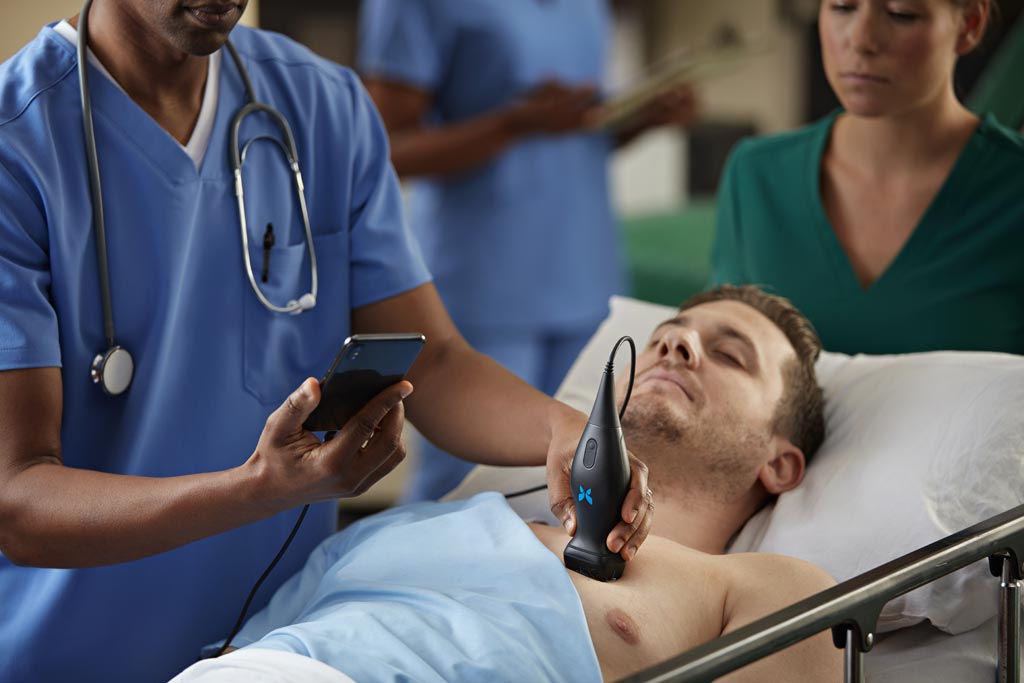
Image: Affordable ultrasound at the point-of care is now possible (Photo courtesy of Butterfly Network).

Butterfly IQ is programmed with 18 preset scanning programs, which enable diagnostic ultrasound imaging of peripheral vessels, including for carotid and arterial studies and procedural guidance; and cardiac, abdominal, urology, gynecological; fetal/obstetric, and musculoskeletal use. In addition, Butterfly Network has developed deep learning-based artificial intelligence (AI) applications that are tightly coupled to the hardware and assist clinicians with both image acquisition and interpretation, which will ultimately enable less skilled users to reliably extract life-saving insights from ultrasound.

The Butterfly iQ is powered by capacitive micromachined ultrasonic transducer (CMUT) technology, which replaces the traditional piezoelectric transducer with a single silicon chip that incorporates an array of 9,000 programmable microelectromechanical systems (MEMS) sensors directly overlaid onto an integrated circuit encompassing the electronics backbone of a high performance ultrasound system, allowing it to emulate any type of transducer - linear, curved, or phased. An integrated 400 mAh Lithium Ion battery provides up to two hours of continuous use.

“Just as putting a camera on a semiconductor chip made photography accessible to anyone with a smart phone and putting a computer on a chip enabled the revolution in personal computing before that,” said Jonathan Rothberg, founder and chairman of Butterfly Network. “Two thirds of the world's population has no access to medical imaging; that's not ok. Butterfly's Ultrasound-on-a-Chip technology enables a low-cost window into the human body, making high-quality diagnostic imaging accessible to anyone.”

Thứ Bảy, 27 tháng 4, 2019

SIÊU ÂM TỤY

Abstract


An ultrasound (US) study is often the first imaging approach in patients with abdominal symptoms or signs related to abdominal diseases, and it is often part of the routine workup. The pancreatic gland, despite its retroperitoneal site, can be efficiently examined with US thanks to advances in US technologies. Nowadays, a pancreatic US study could be considered complete if multiparametric, including the use of Doppler imaging, US elastography, and contrast‐enhanced imaging for the study of a pancreatic mass. A complete US examination could contribute to a faster diagnosis, especially if the pancreatic lesion is incidentally detected, addressing second‐step imaging modalities correctly.

Thứ Hai, 22 tháng 4, 2019

Ultrasound bests x-ray for identifying pulmonary edema.


April 22, 2019 -- Bedside ultrasound is more sensitive than chest x-ray for identifying pulmonary edema in patients presenting with dyspnea, according to a study published in the April issue of the Journal of Ultrasound in Medicine.
And the modality's greater sensitivity isn't its only benefit, wrote a team led by Dr. William Wooten of Mount Carmel Health System in Columbus, OH.
"Bedside ultrasound appears to offer several advantages over chest radiography in the workup of patients with dyspnea beyond its superior sensitivity in the diagnosis of pulmonary edema," the team wrote. "First, bedside ultrasound exposes the patient to less radiation. Second, imaging costs to payers may be reduced."
Chest x-ray has been the commonly used imaging modality to assess patients for pulmonary edema, but its interpretation can be variable, affected by clinicians' level of expertise, Wooten and colleagues wrote. That's why lung ultrasound may be a better tool.
"Lung ultrasound may produce more objective findings through evaluation of vertical comet tail artifacts known as B-lines, which are created by a decrease in the ratio of alveolar air to fluid pulmonary content," the group explained.
The study included 99 patients who presented in the emergency room with dyspnea between August 2016 and March 2017. Of these, 32.3% had congestive heart failure, and 40.4% had chronic obstructive pulmonary disease. Each patient underwent an ultrasound exam within an hour of having a chest x-ray. The researchers used the final diagnosis from the patient's discharge summary as the reference standard (J Ultrasound Med, April 2019, Vol. 38:4, pp. 967-973).
The team found that bedside ultrasound had higher sensitivity compared with chest x-ray, at 96% versus 65%. Specificity was comparable between the two modalities. Of 18 patients with negative x-ray findings and a discharge diagnosis of pulmonary edema, 16 (89%) had positive findings on ultrasound.
Chest x-ray vs. ultrasound for pulmonary edema
MeasureChest x-rayUltrasoundp-value
Sensitivity65%96%< 0.001
Specificity96%90%0.26
Additionally, patients may be more comfortable with bedside ultrasound, Wooten and colleagues noted.
"Anecdotally, we observed that patients appeared to prefer the bedside ultrasound, as it kept the provider at the bedside longer, and the patient did not have to leave the room or family to undergo the chest radiography," the group wrote.
Bedside ultrasound shows promise for patient care when it comes to diagnosing pulmonary edema, but it could also benefit hospitals, according to the authors.

"This study has the potential to affect the care of patients with congestive heart failure, which is the most common cause of hospitalization in the Medicare population and is growing substantially as people are living longer," the team concluded. "As hospitals are being penalized for 30-day readmissions for congestive heart failure, it is crucial that these patients have an accurate diagnosis and are properly treated."

Thứ Tư, 17 tháng 4, 2019

Ultrasound in late pregnancy could reduce C-section rate.


By Kate Madden Yee, AuntMinnie.com staff writer
April 17, 2019 -- Performing ultrasound scans late in pregnancy helps women avoid undiagnosed breech presentation of their babies, translating to improved clinical outcomes, lower rates of emergency cesarean sections (C-sections), and perhaps even lower healthcare costs, according to a study published April 16 in PLOS Medicine.
The findings are good news not only for women and their babies but also for the healthcare system, wrote a team led by David Wästlund of the University of Cambridge in the U.K.
"According to our estimates, universal late pregnancy ultrasound in nulliparous women would virtually eliminate undiagnosed breech presentation, would be expected to reduce fetal mortality in breech presentation, and would be cost-effective if fetal presentation could be assessed for less than 19.80 pounds [$25.95 U.S.] per woman," the group wrote.
Fetal breech presentation increases the risk of complications for the baby and the mother, Wästlund and colleagues noted. Typically, a baby's position is assessed by palpating the woman's abdomen, but this technique's sensitivity varies by practitioner.
"Despite the relative ease with which breech presentation can be identified through ultrasound screening, the assessment of fetal presentation at term is often based on clinical examination only," the researchers wrote. "Due to limitations in this approach, many women present in labor with an undiagnosed breech presentation."
The investigators performed screening ultrasound at 36 weeks gestation in 3,879 English women having first pregnancies between January 2008 and July 2012. Of these, 179 (4.6%) were diagnosed with breech presentation. In more than half of those (54%), breech presentation had not been suspected prior to labor.
Women with babies in the breech position were offered a procedure called an external cephalic version (ECV) to try to turn the baby; for those who did not want this procedure or for whom it did not work, a C-section was scheduled.
The investigators also estimated the cost of universal late pregnancy ultrasound scans using data from the English National Health Service (NHS) to compare birth outcomes of breech pregnancies screened with and without ultrasound.
The ECV procedure was attempted in 84 (46.9%) of the women with breech babies and was successful in 12 (14.3%). Of the 179 women with breech babies, the researchers found the following:
  • 10.6% delivered vaginally (following either a planned or spontaneous version).
  • 61.5% delivered via elective C-section.
  • 27.9% delivered via emergency C-section (due to labor starting before the scheduled cesarean date).
"No woman in the cohort had a vaginal breech delivery or experienced an intrapartum cesarean for undiagnosed breech," the researchers noted.
Wästlund and colleagues estimated that routine late pregnancy ultrasound could prevent nearly 15,000 undiagnosed breech presentations, more than 4,000 emergency C-sections, and seven to eight baby deaths per year. But the effect of the intervention on healthcare costs needs more research, the group wrote: "If universal ultrasound could be provided for less than 12.90 pounds [$16.91] per scan, the policy would also be cost saving." But it's unclear if this is possible.
"If this procedure could be implemented into routine care, for example, by midwives conducting a routine [scan at 36 weeks gestation] and using a portable ultrasound system, it is likely to be cost-effective," the group concluded. "Such a program would be expected to reduce the consequences to the child of undiagnosed breech presentation, including morbidity and mortality."

Elastography can help characterize breast tumors.


By Kate Madden Yee, AuntMinnie.com staff writer
April 16, 2019 -- Breast elastography is an overlooked tool for evaluating breast cancer, especially since it shows promise for helping radiologists distinguish between benign and malignant lesions, according to a presentation delivered at the American Institute for Ultrasound in Medicine (AIUM) meeting in Orlando, FL.
Since ultrasound is convenient, easily accessible, and less expensive than some other modalities, it's a helpful tool in the breast cancer detection arsenal. And since it can help characterize breast lesions, breast elastography could have downstream effects on patient care, according to presenter Dr. Stamatia Destounis of Elizabeth Wende Breast Care in Rochester, NY.
"Identifying the relative tissue stiffness can help clinicians distinguish between benign and malignant lesions, which in turn has the potential to reduce unnecessary biopsies," she said.
Although breast elastography has been available for more than 15 years, it's not widely implemented, in part because the various methods lack consistency -- particularly in color scale interpretation, Destounis noted.
"As research continues and elastography is used in clinical practice, there's a need for standardization of the color scale," she said.
Elastography can be performed in static and dynamic modes, and consensus about which mode is better is generally lacking. Static elastography includes strain imaging, while dynamic elastography includes shear wave. Strain elastography is the most widely used technique, estimating the relative stiffness of a particular area compared with other tissue.
In strain elastography, tissue stiffness data are displayed in a color map that is superimposed on a real-time grayscale image. Cancers tend to appear larger on strain elastography than on B-mode ultrasound, and benign lesions tend to appear smaller; this size change between the modes has shown to be highly sensitive and specific for characterizing breast lesions, Destounis said.
Studies have demonstrated that strain elastography is effective for detecting breast cancer, but it does have its drawbacks.
"It can be difficult to measure the amount of force during compression, and absolute elasticity can't be calculated," she said.
As for shear-wave elastography, it offers real-time, quantitative assessment of tissue stiffness; rather than relying on external compression, it uses short acoustic pulses to identify stiffness. To characterize breast lesions, clinicians should focus on the area of highest stiffness in the lesion. But be careful, Destounis cautioned.
"Some breast cancers don't allow for adequate shear-wave generation and may appear black -- that is, no shear-wave speed calculated or with a low shear-wave speed due to noise," she explained.
So which technique should clinicians use? Destounis cited research from Chang et al that found mixed results (American Journal of Roentgenology, August 2013, Vol. 201:2, pp. W347-356). The study compared strain and shear-wave ultrasound elastography for differentiating benign from malignant breast lesions, and it showed that strain elastography is more specific than shear-wave elastography (93.7% compared with 84.8%) but less sensitive (81.7% compared with 95.8%).
It may be a matter of improving elastography technology, Destounis told AuntMinnie.com via email.
"Several vendors have different types of elastography technology, and it needs more consistency in technique and color representation," she stated.