Tổng số lượt xem trang

Thứ Năm, 19 tháng 3, 2020

US can be used for patients with COVID-19.


By Theresa Pablos, AuntMinnie staff writer
March 19, 2020 -- Ultrasound scans show promise for helping to monitor patients with COVID-19, according to a letter published on March 12 in Intensive Care Medicine. The researchers used lung ultrasonography to monitor more than a dozen patients in China with COVID-19 infections.
Because of its high sensitivity, CT is currently the imaging method of choice to diagnose and monitor patients with COVID-19. However, chest CT may also present difficulties for patients with hypoxemia and hemodynamic failure, and the enclosed environment may contribute to the spread of the coronavirus.
In the research letter, the authors found lung ultrasonography could overcome some of CT's limitations. Ultrasound may even be the better imaging choice for patients in critical condition who cannot be easily moved.
"Based upon our experience, we consider that lung ultrasonography has major utility for management of COVID-19 with respiratory involvement due to its safety, repeatability, absence of radiation, low cost, and point of care use," wrote the authors, led by Qian-Yi Peng, from the critical care department at Xiangya Hospital in Changsha, China.
COVID-19 on lung ultrasound scans
Peng and colleagues performed lung ultrasonography on 20 patients with COVID-19. They used a 12-zone examination method, which resulted in the following five characteristic findings:
  1. Pleural line thickening and irregularity
  2. Variety of B-line patterns, including focal, multifocal, and confluent
  3. Variety of consolidation patterns, including multifocal small, nontranslobar, and translobar with occasional mobile air bronchograms
  4. Visible A-lines during the recovery phase
  5. Rare occurrence of pleural effusions
"The observed patterns occurred across a continuum from mild alveolar interstitial pattern, to severe bilateral interstitial pattern, to lung consolidation," the authors wrote.
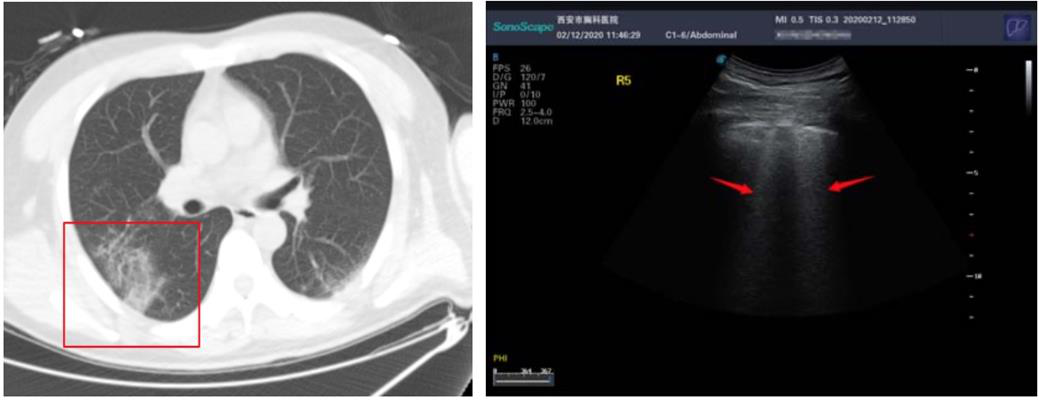
A CT scan and ultrasound scan from one patient with COVID-19
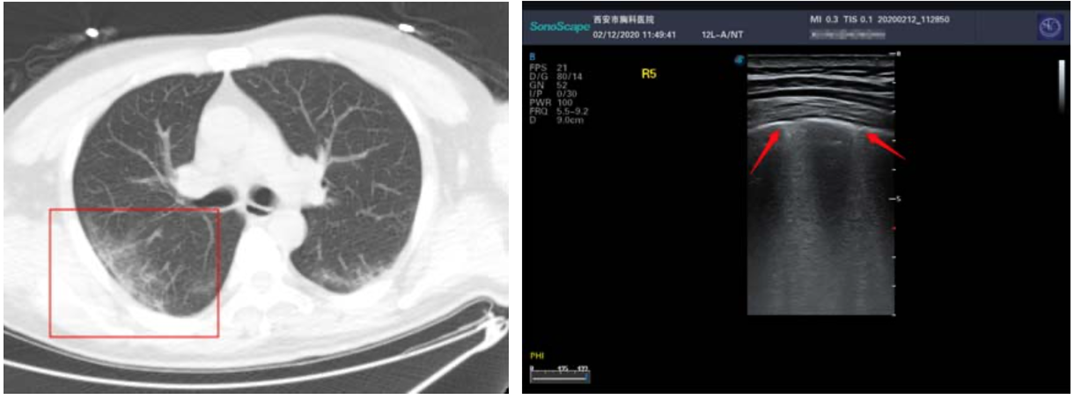
Above: A CT scan and ultrasound scan from one patient with COVID-19. Below: A CT scan and ultrasound scan from a second patient with COVID-19. All images published in SSRN and courtesy of Yi Huang and colleagues.
A CT scan and ultrasound scan from a second patient with COVID-19
During the early stages of COVID-19, patients tended to exhibit focal B-line patterns, followed by alveolar interstitial syndrome as the disease progressed. In patients who were critically ill, ultrasound scans showed A-line patterns in the convalescence. For patients with pulmonary fibrosis, the scans found pleural line thickening with uneven B-line patterns.
"The findings of lung ultrasonography features of [COVID-19] are related to the stage of disease, the severity of lung injury, and comorbidities," the authors wrote. "The predominant pattern is of varying degrees of interstitial syndrome and alveolar consolidation, the degree of which is correlated with the severity of the lung injury."
The findings from Peng and colleagues mirror those of a previous study published on February 28 in SSRN. In the earlier study, lead author Yi Huang and colleagues used ultrasound scans for 20 patients with COVID-19 at the Xi'an Chest Hospital in Xi'an, China.
Huang and colleagues also used the 12-zone examination method and found similar ultrasound scan characteristics to Peng and colleagues. For instance, they found a higher proportion of B-line patterns in lesion areas, including fused B lines, as well as pleural lines that presented as discontinuous, interrupted, or unsmooth.
Better than CT?
The ultrasound scan findings from both studies lined up well with chest CT scans results. For instance, in Peng and colleague's study thickened pleura on CT scans presented as a thickened pleural line on ultrasound. Further, pulmonary infiltrating shadow on CT was linked to confluent B-line patterns on ultrasound.
Similarly, the chest CT scan of one patient in Huang and colleague's study showed ground-glass opacity and air bronchogram sign under the pleura of one lung (Figure 1). The ultrasound scan of the same patient revealed an uneven pleural line and B-line patterns (Figure 2).
While both sets of authors agreed that lung ultrasonography had several benefits over chest CT for patients with COVID-19, they also noted ultrasound shouldn't be used as the only imaging method. For instance, CT is still needed to identify patients who have pneumonia that does not extend to the pleural cavity,
  • "Our study indicated that ultrasound can show typical manifestations and has advantages over CT in the clinical diagnosis and treatment of noncritical COVID-19, but it cannot replace CT," wrote Huang and colleagues. "Ultrasound can be used as a supplemental method."

Thứ Tư, 18 tháng 3, 2020

What US scoring system works best in diabetes?


By Theresa Pablos, AuntMinnie staff writer

March 18, 2020 -- Only one technique to assess medial arterial calcification (MAC) from an ultrasound scan can also predict related cardiovascular and diabetes complications, according to a study published on March 6 in Ultrasound in Medicine and Biology.

The authors evaluated two methods for diagnosing MAC severity:
  1. The presence of MAC in three unique artery segments
  2. The length of MAC in centimeters
Only MAC identified through the segmentation method was able to independently predict whether a patient would also experience peripheral artery disease and diabetic nephropathy, the authors noted. However, both methods for calculating MAC from ultrasound scans were still valuable.
"Consistent with previous studies, the presence and severity of MAC were associated with diabetic complications in our univariate analysis, regardless of whether the length or segmentation method was used," wrote the authors, led by Jing Tian from Sun Yat-Sen Memorial Hospital in Guangzhou, China.
Ultrasound is one tool that can be used to help screen patients with diabetes for MAC, but there is no consensus on the best scoring method to evaluate MAC severity from ultrasound scans. Therefore, the authors compared two commonly used scoring systems: the segmentation method and the length method.
In the length method, MAC severity is determined based on the severity of calcification in a 4-cm scanned area. A MAC length of 0 cm, less than 1 cm, 1 to 2 cm, 2 to 3 cm, and greater than 3 cm on ultrasound scans correspond to MAC scores of 0, 1, 2, 3, and 4, respectively. The scores are then added up, with higher scores indicating higher MAC severity.
In the segmentation method, a point is given for the presence of any MAC in the superficial femoral artery to popliteal artery segment, the anterior tibial artery to dorsalis pedis artery segment, and the posterior tibial artery and peroneal artery segment. Like in the length method, the scores are added up, and higher scores indicate higher MAC severity.
The researchers used both MAC scoring methods on 359 patients with type 2 diabetes who stayed at a hospital endocrinology department between March 2015 and December 2017. A radiologist with 15 years of clinical ultrasound experience performed the bilateral lower limb artery ultrasound examinations on the patients.
About 37% of patients had MAC based on the ultrasound scan findings, but the diagnosis of mild and severe MAC differed based on the scoring approach. Using the length method, the researchers found 105 mild MAC cases and 123 severe cases, whereas the segmentation method identified 98 mild cases and 130 severe ones.
Both methods helped predict the odds of diabetic complications, including peripheral artery disease, peripheral neuropathy, retinopathy, and nephropathy. However, the segmentation method was also an independent predictor of peripheral artery disease and diabetic nephropathy, suggesting it may be better for evaluating cardiovascular abnormalities and risk for diabetes complications.
A main limitation of the study was that it only included ultrasound imaging instead of also using another imaging modality, the authors noted. However, it also demonstrated that two different ultrasound scoring methods can help predict diabetic complications -- although the segmentation might be better.
"MAC scores calculated by the segmentation method were significantly correlated with [peripheral arterial disease] and diabetic nephropathy," they concluded. "The segmentation method for assessing MAC may be a valuable tool in clinical work."

Thứ Năm, 12 tháng 3, 2020

SIÊU ÂM TÔN THƯƠNG PHÔI COVID-19


 Abstract
Background:
Ultrasound is used to observe the imaging manifestations of COVID-19 in order to provide reference for real-time bedside evaluation.
Purpose: To explore the ultrasonic manifestations of peripulmonary lesions of non-critical COVID-19, so as to provide reference for clinical diagnosis and efficacy evaluation.
Materials and Methods: The clinical and ultrasonic data of 20 patients with clinically diagnosed non-critical COVID-19 treated in Xi'an Chest Hospital during January and February 2020 were retrospectively analyzed. Conventional two-dimensional ultrasound and color Doppler ultrasound were used to observe the characteristics of lesions.
Results: All 20 patients (40 lungs and 240 lung areas) had a history of travel, residence or close contact in/with Wuhan, and 5 of them caught COVID-19 after family gatherings. Lesions tended to occur in both
lungs. Lesions in the lung areas: 14 in L1+R1 area (14/40), 17 in L2+R2 area (17/40), 17 in L3+R3 area (17/40), 17 in L4+R4 area (17/40), 20 in L5+R5 area (20/40), and 28 in L6+R6 area (28/40). Lesion types: rough and discontinuous pleural line (36/240), subpleural consolidation (53/240), air bronchogram sign or air bronchiologram sign in subpleural peripleural consolidation (37/240), visible B lines (91/240), localized pleural thickening (19/240), localized pleural effusion (24/240), poor blood flow in the consolidation detected by color Doppler ultrasound (50/53).
Conclusion: The non-critical COVID-19 has characteristic ultrasonic manifestations, which are visible in the posterior and inferior areas of the lung. The lesions are mainly characterized by a large number of
B lines, subpleural pulmonary consolidation and poor blood flow. Lung ultrasound can provide reference for the clinical diagnosis and efficacy evaluation.

Key Words: lung ultrasound; ultrasonic manifestations; novel coronavirus pneumonia (COVID-19)


Chủ Nhật, 8 tháng 3, 2020

U S guides bone metastases pain treatment.

By AuntMinnie.com staff writers

March 5, 2020 -- Using ultrasound to guide focused ultrasound treatment for bone metastases pain is feasible and effective, according to a study published online March 4 in Ultrasound Medicine & Biology.

The study findings offer patients and clinicians an alternative to MRI, which has been the modality most often used to perform the procedure but which has its limitations, wrote a team led by Leah Drost of the University of Toronto in Ontario.
"Previous generations of focused ultrasound devices have featured MR image guidance," the group wrote. "These devices have been found ... to be tolerable, effective, and noninvasive in the palliation of metastatic bone pain. ... However, potential drawbacks of such devices include the cost attached to MR equipment, the immobility of the unit, the complex positioning required of the patient, and the long treatment duration."
Drost and colleagues sought to evaluate whether a standalone, portable focused ultrasound device could be guided by diagnostic ultrasound rather than MRI for this application. The study included nine patients treated with focused ultrasound guided by ultrasound. The team assessed the procedure's safety and efficacy 10 days after it was performed.
The researchers found the following:
  • The procedure was safe and tolerable. Four patients reported minor skin irritations.
  • Average pain score decreased from 6.9 at baseline to 3.2 at day 10. P atients' use of analgesics also decreased from baseline to day 10.
  • Six patients reported "durable" pain relief over the assessment period.
"Our study provides evidence that ultrasound-guided focused ultrasound is a safe, tolerable and versatile procedure," the researchers concluded. "It appears to be effective in achieving durable pain response in patients with painful bone metastases. Further research is required to refine the technology and optimize its efficacy."

Thứ Năm, 5 tháng 3, 2020

Patient and U S features linked to breast cancer


March 4, 2020 -- Nine unique patient and ultrasound features may enable breast imagers to distinguish benign from malignant complex cystic or solid breast lesions, according to research published on February 24 in Ultrasound in Medicine and Biology.
Lesion type, size, orientation, and vascularity were just a few of the features that were found through handheld ultrasound scans and linked to breast cancer. The combination of all nine factors resulted in a sensitivity of 77% and specificity of 82%, the authors reported.
"In addition to identifying whether a lesion is cystic or solid, [handheld ultrasound] is widely applied to tumor diagnosis, biopsy guidance, and even further treatment," wrote the authors, led by Dr. Huiling Xiang from the department of ultrasound at the Sun Yat-sen University Cancer Center in Guangzhou, China. "However, studies related to the diagnostic yield of [handheld ultrasound] in distinguishing benign from malignant complex cystic and solid breast lesions are limited."
The authors defined complex cystic lesions as those that are oval or round in shape with circumscribed margins but also have debris with low-level echoes. These lesions are common in middle-aged women and are often benign, but they do carry a nontrivial risk of malignancy. The researchers therefore wondered whether features on handheld ultrasound might be better able to differentiate complex cystic lesions that needed biopsy and ones that were likely benign.
To find out, the authors used data from 453 patients with 472 complex cystic and solid breast lesions who visited a university cancer center between 2000 and 2018. Radiologists with at least three years of breast imaging experience examined the lesions using handheld ultrasound with a high-frequency linear array transducer.
They also subdivided the lesions into four categories:
  • Type I: Thick wall and/or septations, > 0.5 mm
  • Type II: One or more mural or papillary nodules
  • Type III: Mixed lesion that is more than 50% cystic
  • Type IV: Mixed lesion that is more than 50% solid
The study included a variety of lesion types. About 13% of the lesions were classified as type I, 10% were type II, 21% were type III, and 55% were type IV.
Following biopsy, a little more than half of the lesions were confirmed as benign, while the remaining 45% were deemed malignant. However, the results varied based on lesion type.
The positive predictive value was significantly higher for type III or IV lesions than type I or II lesions. Other factors independently associated with malignancy included the following:
  • Lesion diameter of more than 18 mm
  • Lesion with irregular shape
  • No parallel orientation
  • Uncircumscribed margin
  • Calcification
  • Vascularity in the tumor
  • Abnormal axillary lymph nodes
  • Patient age of 52 or older
A lesion type of III or IV and a lesion diameter of more than 18 mm had the highest sensitivity (87%) and negative predictive value (82%) of any of the factors significantly associated with malignancy. Abnormal findings in axillary lymph nodes had the highest specificity (94%) and positive predictive value (83%).
It is important to note that even type I and type II lesions, which were not linked to malignancy in the study, still met the 2% malignancy threshold to qualify for a BI-RADS 4 categorization and biopsy. While the authors couldn't rule out any lesions as benign, they were able to better categorize them.
"Type I, II, and IV lesions can be assessed as BI-RADS 4B, while type III lesions can directly go into BI-RADS 4C, which allows a more accurate subclassification of complex cystic and solid breast lesions in clinical practice," the authors wrote.
In addition, the researchers excluded complicated cystic lesions without solid components and only included patients who had already undergone handheld ultrasound. As a result, the study may have selection bias.
Nevertheless, the findings reaffirm the power of handheld ultrasound as a powerful, secondary screening tool, the authors noted.
"Therefore, we may safely conclude that the [handheld ultrasound] is a useful modality in differential diagnosis of benign and malignant complex cystic and solid breast lesions and a tool complementing [mammography] in lesion detection," they wrote.

Thứ Hai, 2 tháng 3, 2020

Older athletes have risk of AA.

By Theresa Pablos, AuntMinnie staff writer

February 28, 2020 -- Older endurance athletes may be prone to heart conditions with a relatively high risk of death. Echocardiographic imaging helped identify an enlarged aorta in 25% of older athletes in a new study, published on February 26 in JAMA Cardiology.
Dilation of the aorta is a risk factor for a group of related conditions tied to an in-hospital mortality rate of more than 25%, with age, male sex, and hypertension established as some risk factors for aortic dilation.
The new research suggests long-term endurance exercise may be a risk factor, too.
"Findings from this study fill an important gap in our understanding of how long-term participation in endurance sport affects the cardiovascular system," wrote the authors, led by Dr. Timothy Churchill from the cardiovascular performance program at Massachusetts General Hospital in Boston.
Previous research has found that intense exercise can contribute to aortic dilation, but no studies had looked at the impact of this phenomenon on older endurance athletes. For their study, the authors recruited 442 male and female runners and rowers who participated in competitive athletic activities, including the Boston Marathon and U.S. national-level rowing competitions.
All athletes were between the ages of 50 and 75 and had at least 10 years of endurance training after the age of 40. The authors screened out participants with a personal or family history of relevant heart conditions, including aortopathy and connective tissue disorders.
Transthoracic echocardiographic imaging was performed on the athletes to measure their myocardial structure and function. The authors took aortic measurements in triplicate over three cardiac cycles.
Out of the male athletes, almost one-third had at least one aortic dimension of 40 mm or larger; however, the findings varied by sport. Male rowers accounted for 61% of athletes with an enlarged aorta. The rowers also had a significantly larger raw aortic size and ascending aorta than male runners.
The difference in aortic dilation between male rowers and runners could be explained by the cardiovascular activity requirements of each sport, the authors noted. For instance, running requires sustained, even cardiovascular activity, whereas rowing requires different levels of strain during the stroke motion.
"While speculative, these findings suggest that the pressure stress uniquely present in rowing may represent an important hemodynamic driver of aortic dilation, particularly at the level of the aortic sinuses," the authors wrote.
For female athletes, the findings were much less pronounced. Only 6% of women had aorta measurements of 40 mm or larger, and there was no significant difference between runners and rowers. However, 38% of female athletes would meet the criteria for enlarged aorta if the threshold was lowered to 34 mm, another standard measurement.
Finally, aortic dilation was also linked to elite athlete status, defined as rowers who participated in the Olympics or world championships and marathon runners who completed races in under two hours and 45 minutes. Elite competitors and those with more cumulative years of athletic training had significantly larger aortic dimensions, the authors found.
"To our knowledge, this study presents the first detailed characterization of the prevalence of clinically relevant ascending aortic dilation among aging competitive athletes," the authors wrote.
What these findings mean for clinical outcomes has yet to be ascertained, the authors noted. They theorized the changes in aorta size could be a previously unrecognized but benign adaption to endurance sports. However, the changes could also mean that long-term training could result in overuse pathology with potentially deadly complications.
"Future studies aimed at defining the natural history of aortic dilation in this population with an emphasis on clinical outcomes ... will be required to resolve this fundamental uncertainty," the authors wrote. "In the absence of such data, clinical implications of our findings remain uncertain and will require individualized assessment."